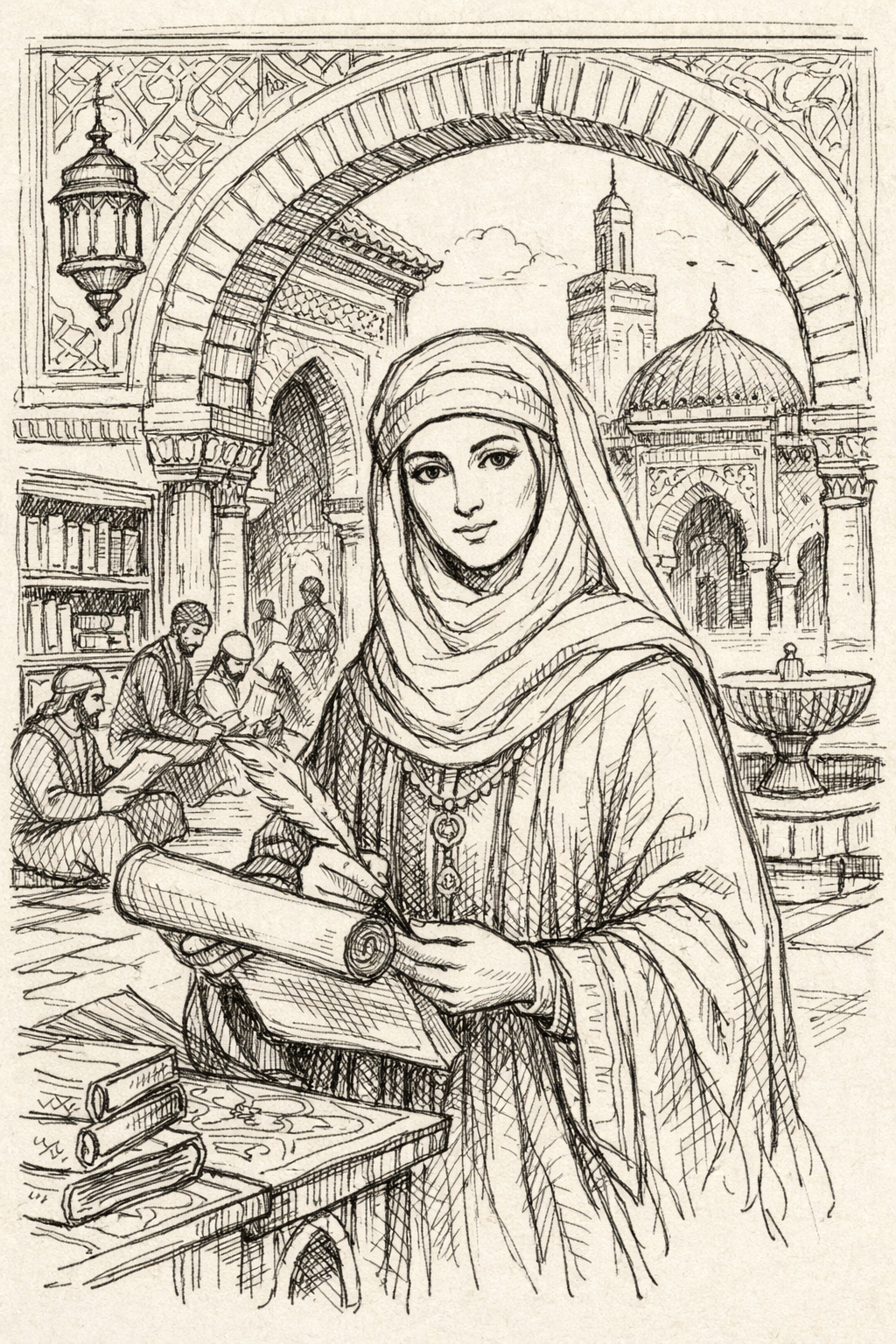
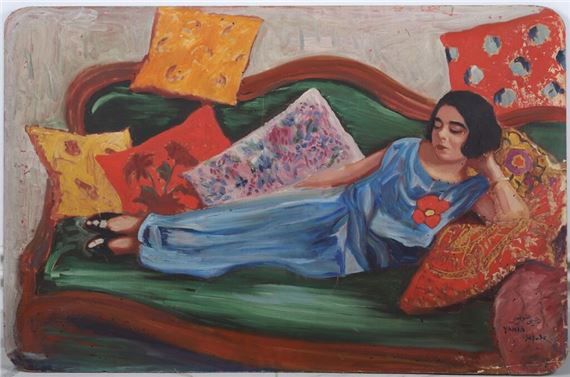
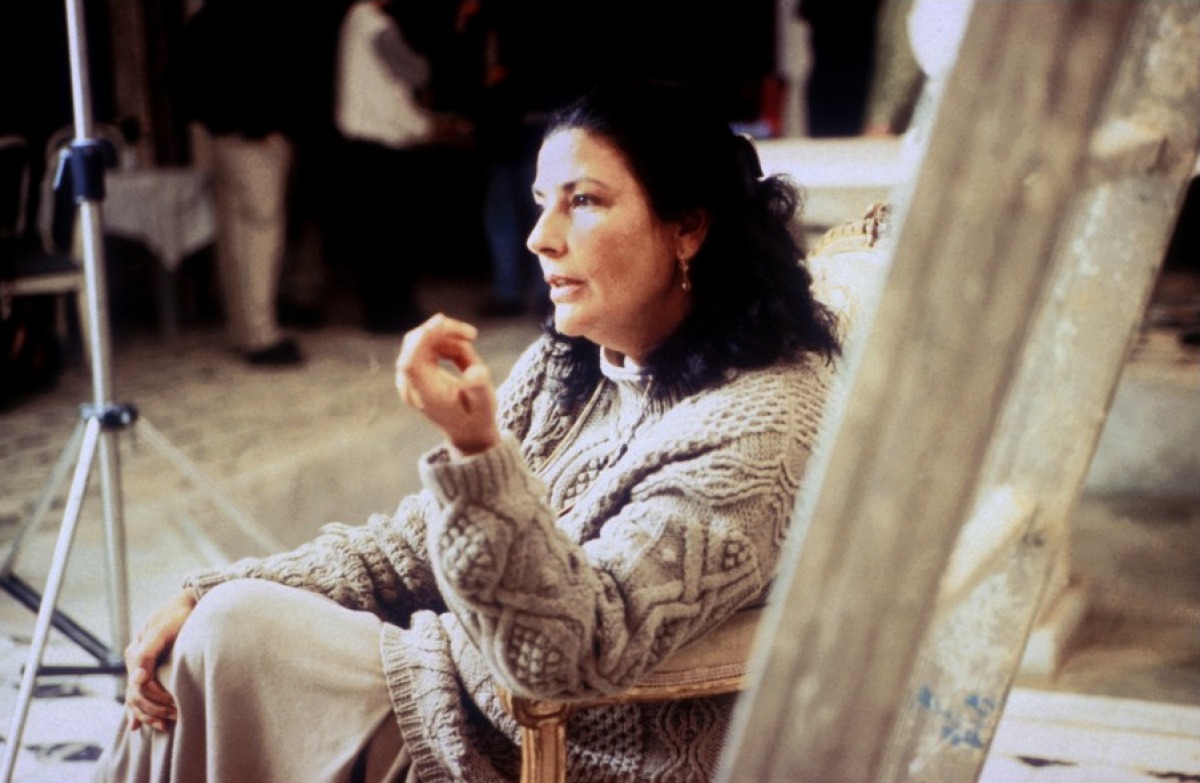
The Story of Radhia Haddad (1922-2003)
Tunis, March 17, 1922
A girl is born into a family of the traditional Tunisian bourgeoisie. Her name is Radhia Ben Ammar. Her father, Salah Ben Ammar, is a man of standing. They live in Tunis, in the Tunisia under French protectorate, in a world where tradition and modernity are beginning to collide .
She grows up in a family that is intellectually open. This matters. It will shape everything .

Tunis, 1934. She is twelve years old.
She has been a brilliant student at the French school in Franceville. She loves learning. She loves reading. She loves the world that opens up when she opens a book .
But her parents have other plans. She is a girl. She has reached the age where girls stop.
They take her out of school. She has her Certificat d'études primaires, her primary school certificate. That is enough. More than enough. For a girl, it is too much, perhaps .
Her brothers continue. Her brother Hassib will go on to secondary school, to university, to become a politician and a human rights activist. Her brothers matter. She is just a daughter .
She will write about this later, in her memoir, Parole de femme. The bitterness does not fade with time. "No sacrifice was deemed too great to facilitate the studies of my brothers," she will write. The words are precise, measured, and full of grief .
But she does not stop learning. She takes Arabic language courses at home. She reads everything her brother Hassib brings from school. She discusses with him, argues with him, learns from him .
And there is something else. The sefseri. The traditional white veil that Tunisian women of good family wear in public. They force her to wear it. She is twelve years old, and they wrap her in cloth, in tradition, in the visible sign of her invisibility .
She hates it. She refuses to leave the house. If she must go out wrapped like a package, she will not go out at all .
But the house is not a prison, not entirely. When the family doctor, Abderrahmen Mami, comes to visit a sick relative, she seizes the opportunity. She talks to him. She asks him about politics. About the Destour, the nationalist party. About the Néo-Destour, the breakaway party led by a young firebrand named Habib Bourguiba. She learns. She listens. She begins to understand that there is a world beyond her walls, and that world is fighting for freedom .
Tunis, 1940. She is eighteen years old.
Her marriage is arranged. Her cousin. Her maternal cousin. This is how families work. You marry within, you keep things close, you trust blood .
She marries him. His name is Haddad. She becomes Radhia Haddad, the name history will remember.
Still veiled, she takes her first steps as a militant. Her husband is a nationalist. Her father-in-law is a nationalist. The house she moves into is full of politics, of meetings, of whispered conversations about independence .
She joins the Union Musulmane des Femmes de Tunisie, the Muslim Union of Tunisian Women founded by Bchira Ben Mrad. She begins her activism quietly, properly, within the bounds of what is acceptable. She participates in solidarity campaigns, collects donations for Tunisian students abroad. She does what women do, the behind-the-scenes work that keeps movements alive .
Tunis, 1946. She is twenty-four years old.
Her father-in-law calls her to a meeting. A political meeting. In their house. Two men from the Néo-Destour are coming: Salah Ben Youssef and Allala Belhaouane. He wants her to attend .
She sits in the room with the men. Her father-in-law. Her husband. The two nationalist leaders. And her. A woman. Listening. Learning. Being treated, for the first time in her life, as someone whose presence matters .
After the meeting, with the consent of the men closest to her, her husband and her father-in-law, she makes a decision. She will remove the veil. She will uncover her face in public. She will walk through the streets visible, present, herself. Persuaded that no one truly holds her to it, she takes it off .
She is twenty-four years old. She never wears it again.
Tunis, 1947
She creates and presides over a new organization: Les Amies des Scouts. The Friends of the Scouts. A women's auxiliary to the scouting movement, which is also a nationalist movement, because under occupation everything is political .
She writes a play. She performs in it. She discovers that she has a voice, a presence, a way of reaching people that goes beyond speeches and meetings .
Tunis, 1952
She formally joins the Néo-Destour. The party of Bourguiba, of independence, of the Tunisia that will be. She will remain a member until 1972 .
Tunis, 1956
Independence is won. The country is free. And on August 13, a revolution happens on paper. The Code du Statut Personnel, the Personal Status Code, is promulgated. Abolition of polygamy. Judicial divorce. Minimum age for marriage. Women are given a place in society that has no precedent in the Arab-Muslim world .
On January 26 of that same year, a group of women gather to found the Union Nationale des Femmes de Tunisie, the National Union of Tunisian Women. Radhia is there, part of the constitutive assembly .
She is thirty-four years old. She realizes, rightly, the dream that the CSP represents for women's rights .
Tunis, April 1958
The first congress of the UNFT meets at the Bourse du Travail in Tunis. Three days of discussions, debates, decisions, from April 7 to 9 .
When it ends, Habib Bourguiba does something that reveals everything about how power works in the new Tunisia. He sends Abdelmajid Chaker, the director of the Néo-Destour, to deliver the results. Aïcha Bellagha, the outgoing president who had been chosen consensually during the constitutive meeting of January 1956, is replaced. Radhia Haddad is designated president .
The vote count is arranged. Radhia and Fethia Mzali come out ahead. Asma Belkhodja-Rebaï, Saïda Sassi (Bourguiba's niece), and Aïcha Bellagha come out behind. Years later, Belkhodja-Rebaï will remember her disappointment. "Our disappointment was great, not because of Radhia Haddad herself, but because of the way the matter was handled. But at that time, disappointment and disagreement did not automatically lead to opposition. And who, in those days, would oppose Bourguiba?" .
Radhia becomes president of the UNFT. She will hold this position for fifteen years, from 1958 to 1972 .
Tunis, 1959
She becomes a deputy in the National Assembly. One of the first female parliamentarians in Africa and the entire Arab world .
She represents Tunis, her city, the place where she was born and schooled and veiled and unveiled. She will sit in the chamber for three consecutive legislatures, from 1959 to 1974 .
Tunis, 1958 to 1972. The years of light.
She works. She builds. She travels across Tunisia, into the interior, into the villages, into the places where women's lives are hardest, most isolated, most forgotten.
She militates for women to learn to read and write, to pursue studies, to work, to ensure their financial autonomy. By her power to convince, first the men who act as intermediaries, then the women themselves, and by her behavior, she succeeds in profoundly transforming society. She does it harmoniously, in calm and understanding, without clashes or backlash .
She founds and directs a quarterly magazine, La Femme. The Woman. Published by the UNFT, it reaches women she cannot reach in person .
Bourguiba looks at her across the halls of power and gives her a title. "I am the president of the men," he tells her, "and you are the president of the women" .
It is a compliment. It is also a cage. She is allowed to preside over women. He presides over everything else.
Tunis, 1969 to 1970
The country cracks. Social crisis. Economic failure. Political turmoil. Bourguiba's health is failing. The question of succession hangs in the air like smoke .
A group forms inside the party and the government. Democrats, they call themselves. Led by Ahmed Mestiri, a powerful former minister of the interior. They want reform. They want to prepare for the day after Bourguiba. They want to save the country from authoritarian drift .
Radhia joins them. She senses, with other militants, the dangers that the president's state of health poses to the country .
This is the decision that will destroy her.
Tunis, March 8, 1972
She resigns from the UNFT. She resigns from the PSD, the party. Fifteen years of work, fifteen years of building, fifteen years of being the president of the women, and she walks away .
Or is she expelled? The sources differ slightly. Catherine Mayeur-Jaouen suggests she was excluded. But most sources, including her own memoir and the Jeune Afrique obituary, state that she resigned . Either way, the result is the same. She is out.
And Bourguiba, the man she admired, the man she served, the man to whom she had "vowed a veritable cult," turns on her .
He humiliates her in public. He drags her through the courts. On flimsy pretexts, on trivial charges, on accusations that everyone knows are false. She is prosecuted, judged, condemned .
Tunis, May 9, 1974
The verdict comes. Four months in prison. Suspended. A fine of one hundred dinars. A "curious trial," the journalists will call it later .
Twenty lawyers defend her. Ahmed Mestiri, her comrade from the democratic group. Béji Caïd Essebsi, who will decades later become president of Tunisia. Also Me Chtourou and Me Arezki Bouzida, the president of the Algiers bar and a great militant of the FLN. They fight for her .
She is marked. Stained. Destroyed as a public figure. She suffers greatly from this disgrace. She will spend the next thirty years in retirement, in silence, in the long shadow of a man's revenge .
Carthage, 1972 to 2003. The years of silence.
She withdraws. She lives quietly. She starts a small publishing house. She names it Elyssa, after the Phoenician queen who founded Carthage. Another woman who built something that lasted .
She does not speak publicly. She does not protest. She does not explain. She simply disappears from the world she helped create.
Tunis, 1995
Her memoir appears. Parole de femme. Word of a woman. The word of this woman .
The book is structured around four key periods of her life: The years of lead, the years of apprenticeship, the years of light, and the years of resistance .
She writes about everything. Her childhood, her education stolen, her brothers who got to learn while she stayed home. The veil, and the day she took it off. The years of building, of traveling, of teaching women to read. The fall, the humiliation, the trial. The man she admired who destroyed her.
She writes about Bourguiba without bitterness, almost without anger. She tries to understand him. About the Personal Status Code, she writes that without his action, "no radical reform could have succeeded. I believe this will be his greatest merit before History. Because if all countries eventually free themselves from foreign domination, none, and especially no Arab-Muslim country, dared a social revolution of such magnitude" .
She writes about the democrats, about Mestiri, about the hope of reform. She writes about the trial, the lawyers, the sentence. She writes about being a woman in a man's world, even when that man called her president.
The book is a document. A testimony. A voice from the silence.
Carthage, October 20, 2003
She dies at home. Eighty-one years old .
The party that expelled her, the RCD, the inheritor of Bourguiba's legacy, issues a tribute. They speak of her warmly, respectfully, as if they had never turned on her .
Ridha Kéfi writes her obituary in Jeune Afrique. He calls her "la présidente des femmes." The title Bourguiba gave her, the title she earned, the title that stuck .
Her grandson survives her. His name is Youssef Chahed. Years later, he will become the head of government of Tunisia .
Tunis, November 19, 2011
The revolution has happened. Ben Ali is gone. The streets are being renamed, the old regime's symbols replaced.
The Rue de Yougoslavie, in the center of Tunis, is renamed by interim president Fouad Mebazaa. It becomes the Rue Radhia Haddad .
In August 2012, it becomes official. The first street in the capital named for a woman. The only one, for years .
If you walk through Tunis today, you can find it. Not far from Avenue Habib Bourguiba, the main artery of the city. A street named for the woman he called president, then destroyed, then forgot, then remembered.
A street named for Radhia Haddad.
Tunis, 2026. Today.
You can walk down the street that bears her name. You can visit the room in the Bardo that bears her name. You can listen to her voice, resurrected by an actor, telling her own story.
But the real monument is invisible. It is in every Tunisian woman who works, who votes, who runs for office, who refuses to be silenced. It is in the literacy classes that still operate, the family planning clinics that still exist, the laws that still protect, however imperfectly.
Radhia Haddad did not write those laws. Bourguiba did that. But she made them real. She walked into villages and told women they could learn to read. She sat in parliament and voted. She built an organization that reached across the country. She spent fifteen years turning paper rights into flesh-and-blood reality.
And then she was destroyed. Because she dared to question. Because she joined the democrats. Because she wanted the country to survive the man who made it.
She spent thirty years in silence. But she wrote it all down. Parole de femme. Word of a woman. Her word. True word.
She was born in 1922, when girls were pulled from school at twelve. She died in 2003, having helped change her country forever. In between, she was a militant, a deputy, a president, a pariah, a publisher, a writer, a grandmother.
The president of the women.
Still president.
Still theirs.


.png)
More
more
like this
like this
On this blog, I write about what I love: AI, web design, graphic design, SEO, tech, and cinema, with a personal twist.