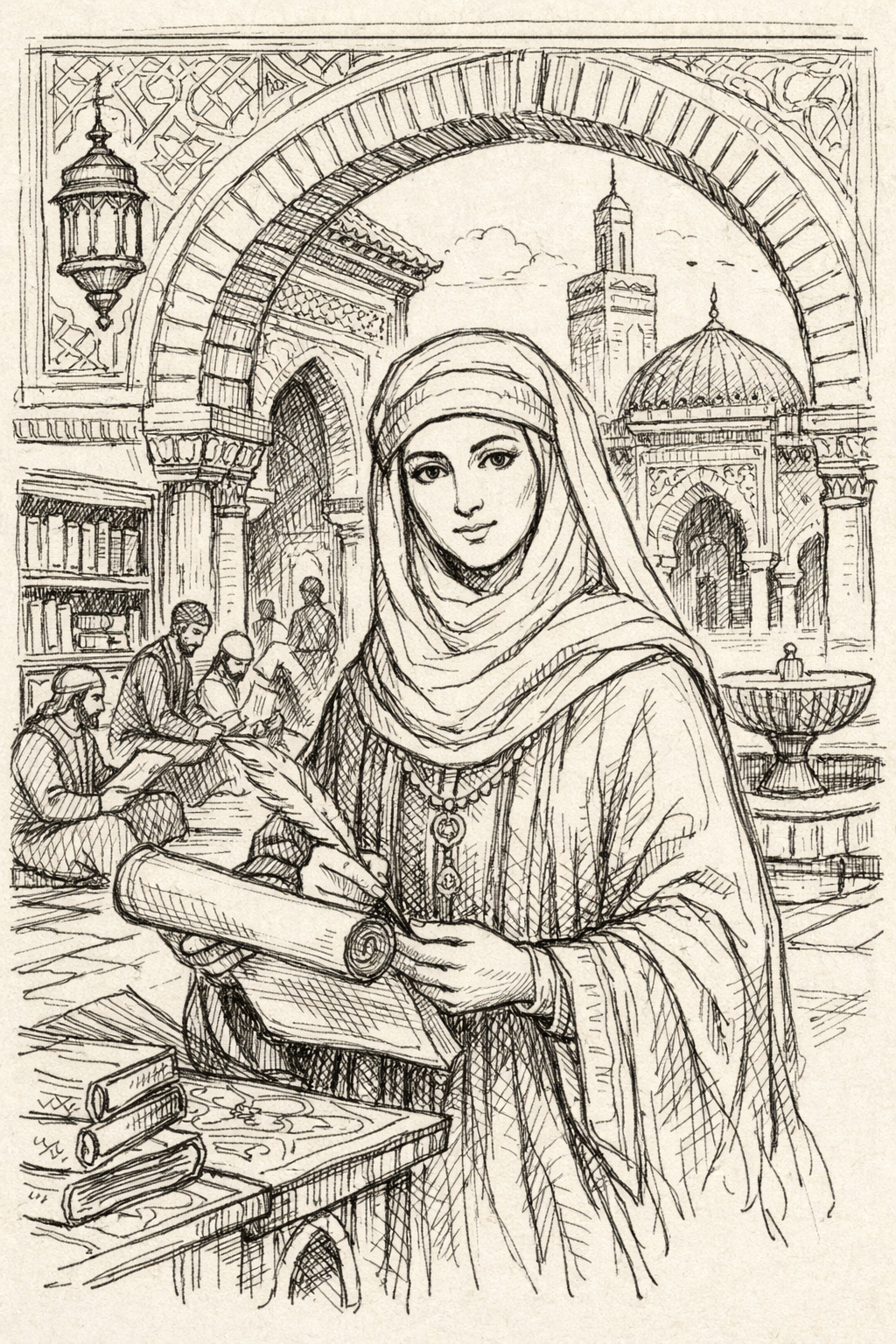
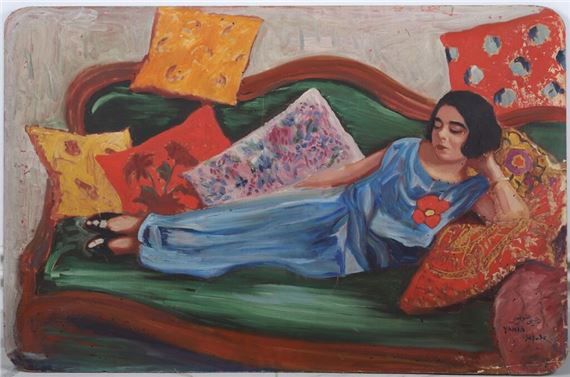
The Story of Moufida Tlatli (1947-2021)
Sidi Bou Said, August 4, 1947
A girl is born in the blue-and-white village overlooking the Gulf of Tunis, the most beautiful postcard in Tunisia. White walls, blue doors, bougainvillea tumbling over every terrace. Tourists will come from everywhere to photograph this place, to pretend they live here, to buy paintings of its perfect streets .
But for the girl born into a traditionalist family, beauty is not the same as freedom . The walls are white, but walls are still walls. The doors are blue, but doors can close as well as open. She will spend her life trying to open them.
They name her Moufida. She will make the name mean something.
Sidi Bou Said, 1960s. She is a teenager.
Her philosophy teacher changes everything.
Not by teaching her what to think, but by showing her that thinking itself is possible. That questions are allowed. That a girl with a mind can use it.
Through this teacher, she discovers cinema. Not as entertainment, not as escape, but as a way of seeing, a way of saying, a way of breaking silences .
She decides. She will go to Paris. She will study film. She will learn how to make the images that live inside her head.
In 1965, she leaves Tunisia. She is eighteen years old .
Paris, 1965 to 1968
The Institut des Hautes Études Cinématographiques, IDHEC, is the most prestigious film school in France. The ancestor of La Fémis. The place where future directors learn their craft .
She studies editing and screenwriting. She learns how images fit together, how rhythm works, how a cut can change everything. She learns the technical side of cinema, the invisible craft that makes movies work .
Three years pass. She graduates in 1968, a year of revolutions everywhere. But her revolution will come later, and it will be quieter, and it will cut deeper .
Tunis, 1972
She returns home. Not to make her own films yet, but to help others make theirs. She becomes an editor, one of the most important editors in Arab cinema .
For more than twenty years, she works in the shadows. Cutting. Shaping. Saving. Making other people's visions coherent, beautiful, true. She edits some of the most important films of the era :
Omar Gatlato by Merzak Allouache, an Algerian classic about masculinity and frustration. Nahla by Farouk Belloufa. La Mémoire fertile by Michel Khleifi, a Palestinian film about memory and displacement. Halfaouine: Child of the Terraces by Férid Boughedir, the most beloved Tunisian film of its generation, a story about a boy discovering sexuality and the world .
She edits Fatma 75 by Selma Baccar, a landmark film about Tunisian women's history . She is part of a network, a community, a movement. Arab cinema is finding its voice, and she is helping it speak.
But she has her own voice too. And it will not stay silent forever.
Tunis, 1993. She is forty-six years old.
Something happens. Her mother falls suddenly, severely ill .
And Moufida realizes something that shocks her. She knows almost nothing about her mother's life. The woman who raised her, who sacrificed for her, who shaped her, is a stranger in crucial ways. What did she suffer? What did she endure? What did she never say?
This realization becomes a film. Not a documentary about her mother, but something deeper. A fiction that tells the truth. A story about a palace, about servants, about women whose bodies are not their own, about silences that last for generations.
She writes it with Nouri Bouzid, another giant of Tunisian cinema . She draws from her mother's experience, from the experiences of all the Arab women who came before, from the things that were never spoken aloud.
The film is called The Silences of the Palace.
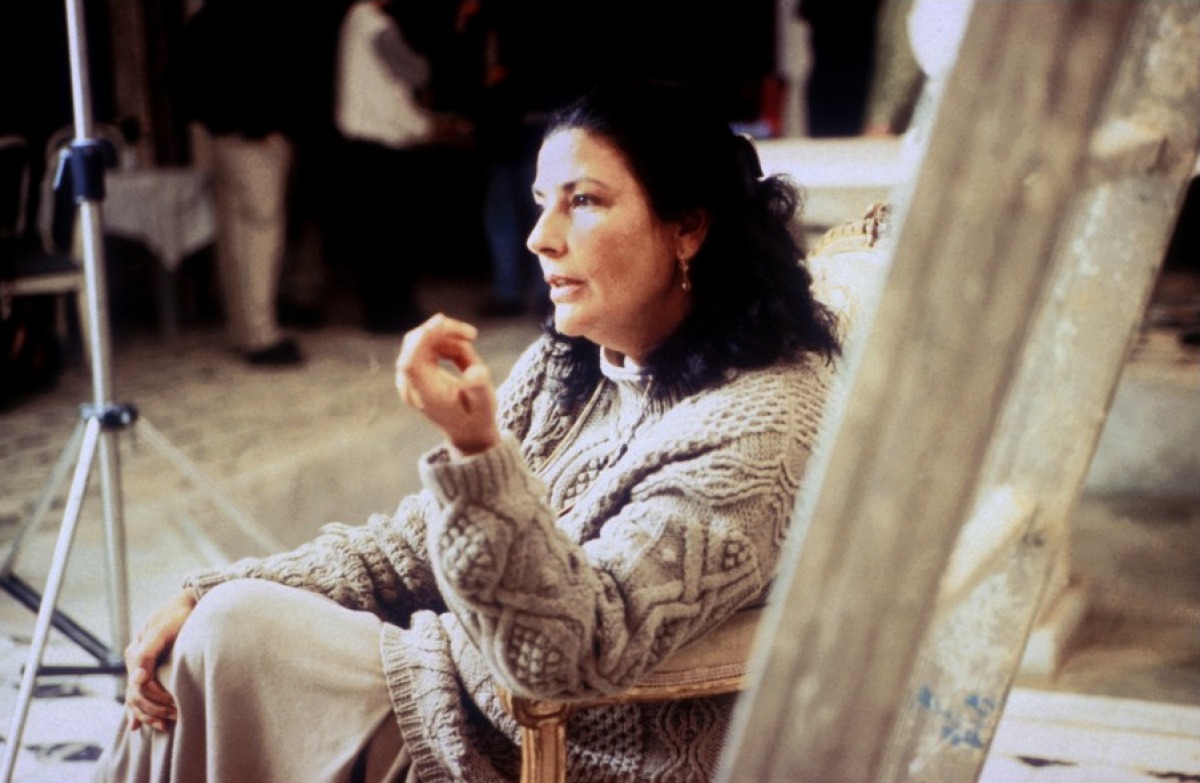
Tunis, 1994. The set.
She directs actors who will become legends. Amel Hedhili. Najia Ouerghi. And a young woman making her film debut, a law student named Hend Sabri, who will go on to become the biggest star in the Arab world .
The story moves between two times. The 1950s, during the French occupation, inside a prince's palace. And the 1960s, after independence, as a young woman named Alia returns to the palace where she grew up.
In the past, Alia is a child, the daughter of a servant named Khedija. She watches the women in the kitchen, the servants who cook and clean and laugh and suffer together. She watches her mother. She begins to understand that her mother is not just a servant, but also a mistress, forced to give sexual favors to the princes. That Alia herself is the product of that violence, that exploitation, that silence .
She learns that her mother died during a self-performed abortion, bleeding to death while Alia sang at a party upstairs .
In the present, Alia is pregnant. Her lover, a revolutionary who once rescued her from the palace, wants her to have an abortion. She must decide. She must understand her past to face her future .
The film is about all the things that cannot be said. The sexual exploitation of servants. The class divisions that destroy women. The abortions performed in secret, in shame, in blood. The fathers who are never named. The mothers who cannot protect their daughters. The nation that wins independence but leaves its women behind .
Moufida films it in long takes, slowly, patiently. She refuses fast cutting, Western rhythms. She wants the camera to move like the women move, with all the time in the world, because their lives are slow, because the kitchen is the heart of the film, because poetry requires accumulation .
"The women, the servants who work in the palace, have the whole day to do the cooking, to wash and to iron," she says later. "I couldn't allow myself to show them in an 'efficient' montage, which would be false, because the content and the form would not correspond. I had to show them in their own rhythm, in their own way of living and breathing. I had to show the slowness of their lives through my use of the camera" .
Cannes, May 1994
The film screens in the Directors' Fortnight, not the main competition, but a prestigious section nonetheless .
The critics go silent. Then they erupt.
The Silences of the Palace wins the Golden Camera, the award for best first film . Moufida Tlatli becomes the first Arab woman to direct a feature-length film in the Arab world .
The awards pile up. The Golden Tanit at the Carthage Film Festival, the most important prize in African and Arab cinema . The Sutherland Trophy from the British Film Institute . The International Critics' Award at the Toronto International Film Festival . The Golden Tulip at the Istanbul International Film Festival . A mention at Cannes, then the Golden Camera itself .
Time magazine names it one of the ten best films of 1994. It sits at the bottom of the list, below Pulp Fiction, below films by Kieslowski and Téchiné, but it is there. A first film by a woman from Tunisia, a country struggling to build a film industry, listed among the best in the world .
Caryn James of The New York Times calls it "a universal coming-of-age story with a feminist twist" . Kevin Thomas of the Los Angeles Times praises her "flowing, sensual style" and calls the film both "brutal" and "tender" .
In 2012, the critic Mark Cousins will name it one of the ten best African films ever made .
Moufida Tlatli has arrived. She is forty-seven years old. She has been working in cinema for more than two decades. But this is her debut. This is her voice. This is what she waited to say.
Tunis, 2000
Her second film, The Season of Men, screens at Cannes in the Un Certain Regard section .
It tells another story of women, this time on the island of Djerba, where men leave for months to work in the capital, and women wait. And wait. And wait. The film explores what happens to women's lives when men are absent, when tradition traps them, when the only release is madness or rebellion .
It wins the Grand Prix of the Arab World Institute in Paris, and prizes at festivals in Namur, Valencia, Turin, and Stuttgart .
Cannes, 2001
She sits on the jury of the Cannes Film Festival. Only the second director from the Maghreb to do so, after Férid Boughedir a decade before .
She judges the films of others, the best in the world. She has earned her place at this table.
Harvard, 2004
Her third and final film, Nadia and Sarra, is released. It tells the story of a mother and daughter, the bonds that hold them together, the forces that tear them apart. Hiam Abbass, the great Palestinian actress, plays the lead .
The same year, Harvard University gives her the McMillan-Stewart Award .
Tunis, January 17, 2011
The revolution has happened. Ben Ali has fled. The country is in chaos, hope, fear, uncertainty. A provisional government is formed under Prime Minister Mohamed Ghannouchi.
Moufida Tlatli is named Minister of Culture. The first woman to hold this position in Tunisia .
She is not affiliated with any party. She is an "independent," chosen for her stature, her integrity, her voice. A filmmaker now asked to help rebuild a nation .
Tunis, January 27, 2011
Ten days later, she is gone.
The reason emerges. In the summer of 2010, before the revolution, before anyone knew what was coming, she signed an appeal. A petition asking Ben Ali to run for reelection in 2014 .
In the new Tunisia, this is unacceptable. The revolutionary youth, the activists who risked their lives, cannot accept a minister who endorsed the dictator. She is replaced by Azedine Beschaouch .
Her political career lasts ten days. A blink. A mistake. A moment that will shadow her legacy.
But she does not defend herself publicly. She does not explain. She simply returns to the work she has always done. Cinema.
Tunis, February 7, 2021
The pandemic sweeps the world. COVID-19 does not distinguish between the famous and the forgotten, the revolutionary and the collaborator, the artist and the bureaucrat.
Moufida Tlatli dies at seventy-three .
Andrew Pulver in The Guardian calls her "the Silences of the Palace director," as if that one film contains everything. Perhaps it does .
Alex Traub in The New York Times writes that she was "a groundbreaker in Arab film." The headline gets her age wrong, says she was seventy-eight, but the tribute is genuine .
She leaves behind her husband, Mohamed Tlatli. Her daughter, Selima Chaffai. Her son, Walid. Five grandchildren .
And three films. Three feature films in twenty-seven years. Not a large output. But each one a document, a testament, a breaking of silence.
Tunis, 2026. Today.
You can watch The Silences of the Palace online, if you know where to look. You can see Hend Sabri as a young woman, before she became a star. You can see the kitchens of the palace, the long takes, the slow movements of women who have nowhere to go. You can hear the forbidden nationalist anthem that Alia sings, the moment of rebellion that costs her mother everything.
You can read interviews with Moufida, preserved in archives, in film journals, in the memories of those who knew her. You can hear her voice explaining why she filmed the way she did.
"The kitchen is the living heart of the film," she said. "It's the place where the women live, work, laugh, sing, dance, eat, communicate or not. It's there that the women have to create a world in order to survive. The world of the first floor is closed. The princes and princesses are shut in their own individual rooms and their own particular solitude" .
She spoke about poetry and cinema, about the indirectness of Arab culture, about the camera as an instrument for capturing what cannot be said directly.
"Poetry is made up of a superimposition of images on words. Perhaps this culture of the indirect has advantages over a culture valuing simple and direct expression. Here everything is a little bit devious, a bit unformulated, the unsaid, and so on. This is why the camera is so amazing. It's in complete harmony with this rather repressed language. A camera is somewhat sly and hidden. It's there and it can capture small details about something one is trying to say, so in a sense it can be an instrument for poetry" .
She was speaking about film. But she was also speaking about her life, her country, her women.
Sidi Bou Said, 1947 to 2021
The girl born in the blue-and-white village became the woman who broke the silences.
She did not break them all. She could not. Some silences are too deep, too old, too protected by power and tradition and shame. But she broke enough. She made films that let women see themselves, that let men see women, that let Tunisians see the country they were building on the backs of servants and mothers and daughters who never got to speak.
She made mistakes. She signed a petition she should not have signed. She served a government for ten days and then was erased from it. But her films remain. And in them, she tells the truth.
About the palace where women are exploited and never named. About the island where women wait for men who never return. About the mother and daughter who love each other across generations of pain.
About the silence that surrounds sexual violence. About the abortions performed in secret, in shame, in blood. About the fathers who are never acknowledged. About the mothers who cannot save their daughters but keep trying anyway.
These are Tunisian stories. They are also universal stories. Every country has its palaces, its servants, its silenced women. Every country has its Moufida Tlatli, or needs one.
She died of a virus that shut down the world. But the world she opened stays open.
Cannes, 1994. The night she won.
She stands on stage, forty-seven years old, holding the Golden Camera. A woman from Tunisia. An Arab woman. A woman who edited other people's films for twenty years before making her own.
The flashbulbs pop. The applause rises. She smiles.
Behind her, in the dark of the theater, the film still plays in the minds of everyone who saw it. The kitchens. The long takes. The mother dying while her daughter sings. The silence that is finally, after all these years, broken.
She thinks of her own mother. The illness that sparked the film. The life she never knew. The woman who raised her and suffered for her and never told her everything.
This is for her, Moufida thinks. This is for all of them.


.png)
More
more
like this
like this
On this blog, I write about what I love: AI, web design, graphic design, SEO, tech, and cinema, with a personal twist.