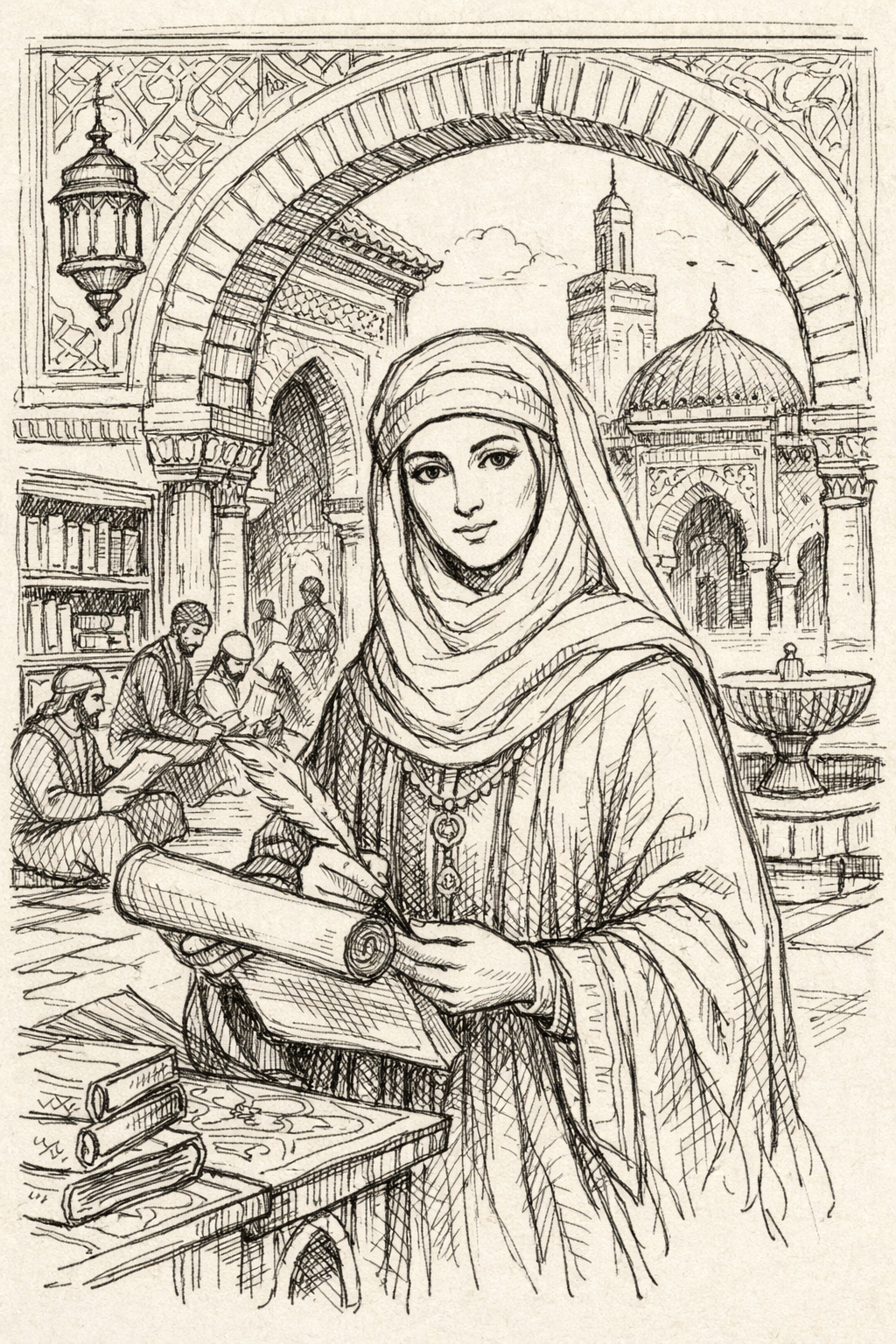
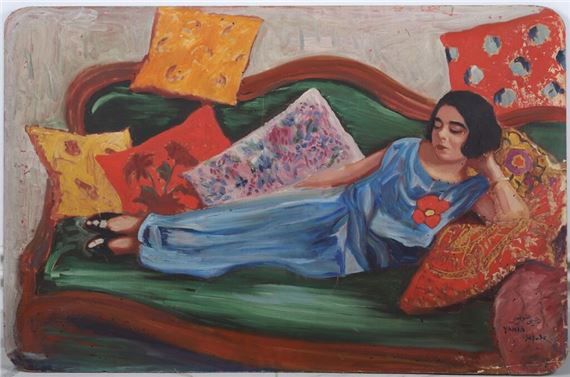
The Story of Aziza Othmana (1606-1669)
Tunis, 1606
A girl is born into the highest circle of power in Tunisia. Her grandfather, Othman Dey, is the military commander of Tunis, elected by the Janissary corps. Her father, Ahmed Dey, will succeed him. The family rules at the pleasure of the Ottoman Empire, but in practice, they govern Tunisia itself .
They name her Fetima. Fetima Othmana. But no one will remember her by that name .
She grows up in her grandfather's palace, surrounded by scholars, poets, jurists. The old man dotes on her. He brings the best teachers in Tunis to educate her. She studies the Quran deeply. She learns Islamic law, literature, poetry, languages. In an age when most women receive no education at all, she receives the finest education available in the land .
Her father watches her grow and sees something rare. He calls her "the ornament of his house," not just for her beauty, which is considerable, but for her mind, her quickness, her precocious intelligence .
The Spanish have just been driven out after nearly half a century of occupation. Tunisia is healing, rebuilding, absorbing waves of Andalusian refugees fleeing the Inquisition. Othman Dey is overseeing this reconstruction, this integration of displaced Muslims into Tunisian soil. His granddaughter watches, learns, absorbs something about what it means to care for the displaced, the wounded, the homeless .
She is being prepared for something, though no one yet knows what.

Tunis, 1620s. She is a young woman.
Her father arranges her marriage to Hammouda Pacha Bey, a powerful man from the Mouradite dynasty that will eventually rule Tunisia. The union joins two great families, two sources of power .
She leaves her grandfather's palace and moves to Dar Hammouda Pacha, a magnificent palace in the heart of the medina. She becomes a wife, a princess, a woman of the court. She performs her duties. She manages households. She bears children. She does everything expected of her .
But she also does something unexpected. She performs the Hajj, the pilgrimage to Mecca. And she takes her servants and slaves with her .
This detail matters. In the 17th century, a princess traveling to Mecca with her household is not unusual. But what happens afterward is unprecedented.
Somewhere on the road to Mecca, 1630s. The exact year is lost.
She stands in the holy places. She performs the rituals. She prays.
And something shifts inside her.
The sources don't tell us what she experienced, what revelation came to her in that sacred landscape. But when she returns to Tunis, she is not the same woman.
She begins freeing her slaves. One by one, in groups, eventually all of them. The men and women her family owned, who served her, who accompanied her to Mecca, who were property under the law, become free people .
This is not a small thing. In the 17th century, slave-owning is normal. The wealthy own slaves. The powerful own many slaves. Freeing them is legal but unusual. Freeing all of them is extraordinary.
But she is just getting started.
Tunis, 1640s
She begins giving away her land. More than ninety thousand hectares of planted and sown fields, farms, orchards, olive groves. The accumulated wealth of generations. The source of her income, her power, her status .
She converts it all into habous, an inalienable religious endowment. The land will generate revenue forever, but that revenue will not go to her heirs. It will go to charity .
What charity? She is specific. She creates funds to free slaves and ransom prisoners captured in war or by pirates. She creates funds to provide dowries for poor girls who cannot afford to marry. She creates funds to feed the hungry, clothe the naked, shelter the homeless .
And then she does something even more remarkable. She founds and finances a hospital.
Tunis, 1662
The Bimaristan, as it is called in Arabic, opens on Rue El Azzafine in the medina. A place where the sick can come for treatment regardless of their ability to pay. A place where the poor can access healthcare, which in the 17th century is a privilege of the wealthy .
She doesn't just donate money. She oversees, plans, ensures that the hospital will function, that it will last, that it will serve the people she loves. She builds an institution that will outlive her by centuries .
The hospital will eventually move, be renamed, be absorbed into the modern Tunisian medical system. But it will always carry her name. Today, it is the Hôpital Aziza Othmana, one of the major hospitals in Tunis, still serving the sick, still bearing witness to her vision .
Tunis, 1669. She is sixty-three years old.
She has given away almost everything. The ninety thousand hectares are gone. The slaves are free. The hospital stands. The funds flow to prisoners, to brides, to the hungry.
She writes her will, and in it she dispossesses herself completely. Everything she still owns goes to charity. Her heirs will inherit nothing from her but her name and her example .
And then she adds one final instruction, a small thing that reveals everything about her.
She asks that fresh flowers be placed on her grave every day. Roses in season. Violets. Jasmine. She wants beauty to continue after she is gone. She wants someone to remember, to care, to tend .
"I want there to be flowers on my tomb every day," she says. A small request. A large demand on the living.
She dies at the end of 1669, which corresponds to the year 1080 of the Muslim calendar .
They bury her in the family mausoleum at a place called Halqat Al-Naâl, deep in the Impasse Ech Chamaiya in the medina of Tunis, near the madrasa of the same name. The building has two domes. Under them lie her relatives, her loved ones, the people who shared her life .
A wooden screen connects her tomb to the zaouia of Sidi Ben Arous, a famous saint of Tunis. She was his devotee in life. In death, she rests beside him, though a wall separates them. Centuries later, in the 1990s, that wall will be removed, and their tombs will stand side by side .
Tunis, 2026. Today.
You can visit her tomb in the medina. If you know where to look. If you can find the Impasse Ech Chamaiya, deep in the winding streets, past the shops and the houses and the hidden doors.
The building still stands. The two domes still rise. The graves of her family still line up beneath them.
And on her tomb, if you come on the right day, you might find flowers. Roses. Violets. Jasmine. Someone remembers. Someone tends. Someone fulfills the request she made nearly four centuries ago.
The hospital still operates on the edge of the medina. Sick people still enter its doors. Poor people still receive care. The institution she founded in 1662 still serves the people she loved.
Her name is on the hospital. On a postage stamp. On an airplane. On the lips of historians who study the Mouradite dynasty. On the pages of books like Sophie Bessis's Les Valeureuses, which tells the stories of five extraordinary Tunisian women .
But her real legacy is not in names and stamps and planes. It is in the prisoners ransomed, the slaves freed, the brides married, the sick healed. It is in the act of a woman who looked at everything she owned and decided it was not hers to keep.
She was a princess. She could have lived comfortably, died wealthy, left fortunes to her children. Instead, she gave it all away. Ninety thousand hectares. Slaves by the dozens. A hospital that still stands. Funds that still flow.
She did it quietly. Without speeches. Without manifestos. Without demanding recognition. She simply looked at the world, saw suffering, and used what she had to reduce it.
The people noticed. They gave her a name that appears nowhere in the official records, nowhere in the wills, nowhere in the legal documents. They called her Aziza. Beloved. The beloved one .
She was Fetima Othmana by birth. She became Aziza by the choice of the people she served.
Tunis, 1669. The day she died.
The city mourns. Not because a princess has died, though that would be reason enough. But because the woman who fed them, healed them, freed them, married them, is gone.
They carry her through the streets. They weep. They remember.
And then, the next day, someone brings flowers. And the next day, someone else. And the next.
For nearly four hundred years, someone has brought flowers to the tomb of Aziza Othmana.




.png)
More
more
like this
like this
On this blog, I write about what I love: AI, web design, graphic design, SEO, tech, and cinema, with a personal twist.