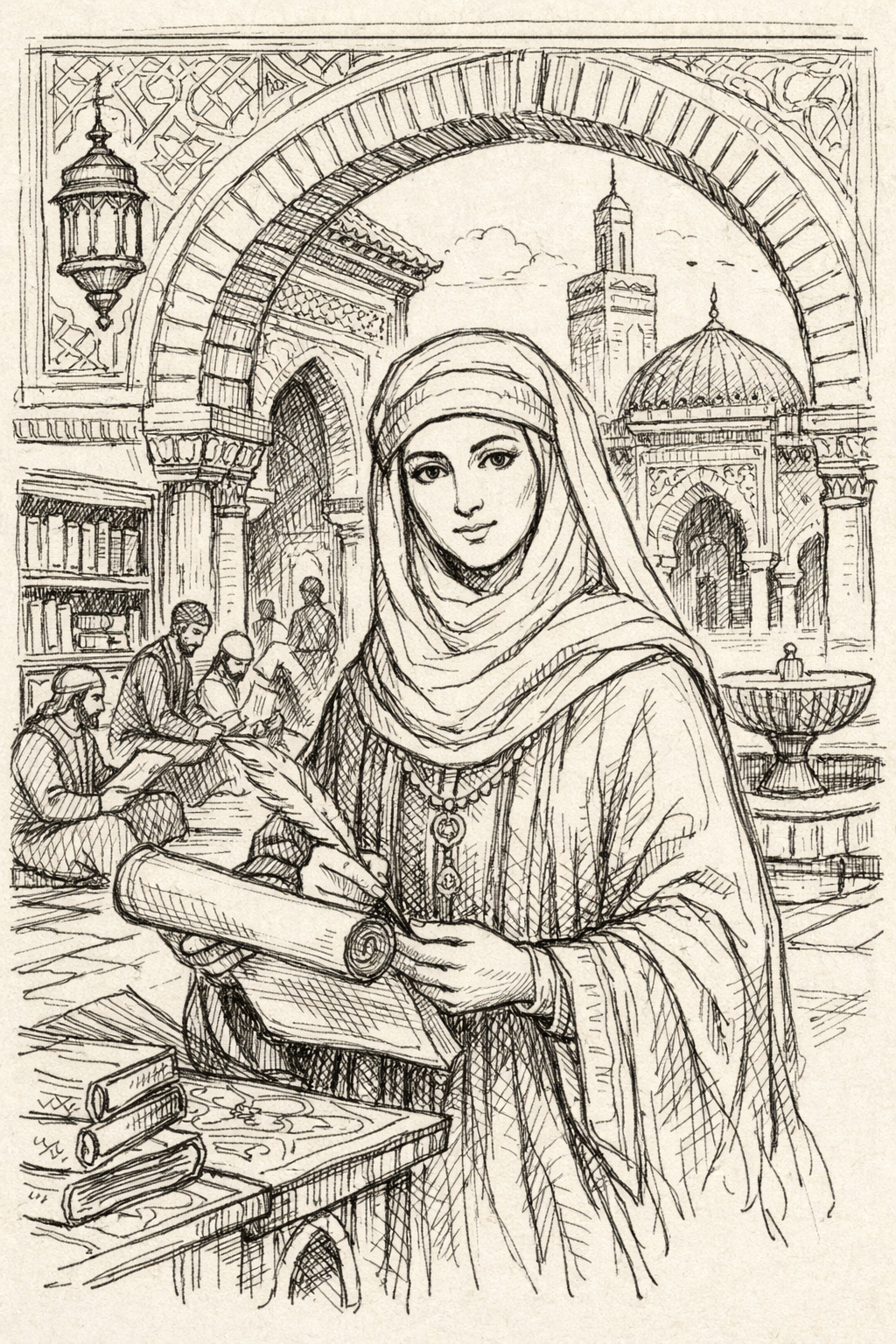
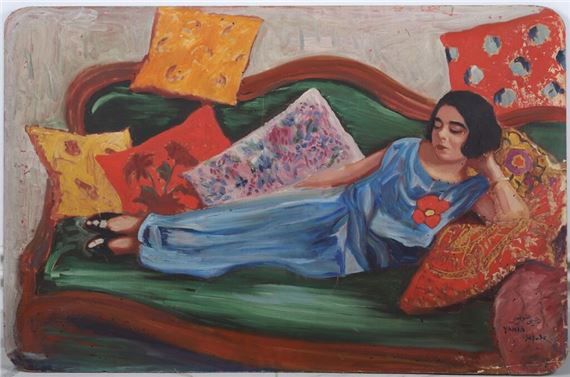
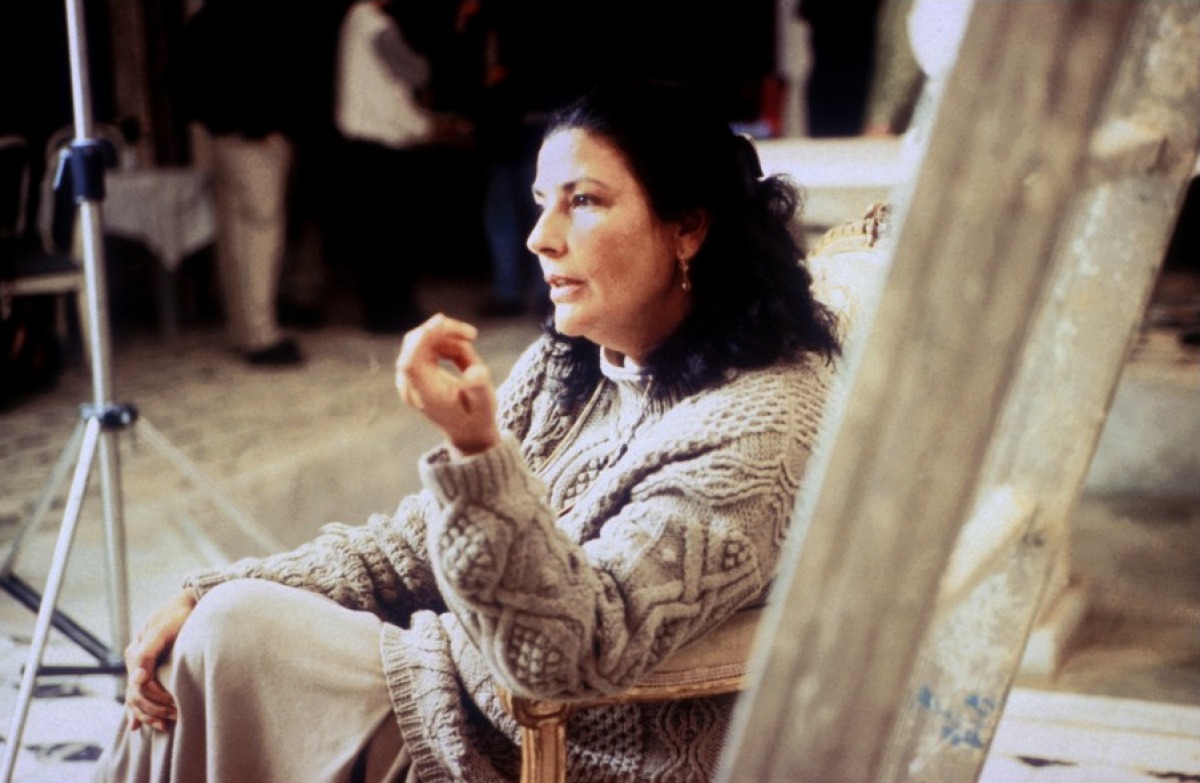
The Story of Lalla Manoubia (1199-1267)
Manouba, 1199
A girl is born in a small village a few kilometers from Tunis. Her father names her Aïcha. No one knows yet that she will become one of the most extraordinary women in Tunisian history. That nearly a thousand years later, women will still visit her tomb, light candles, whisper their secrets to her. That two zawiyas will bear her name. That she will be called "Lalla"—Our Lady—by a people who don't give that title lightly. But first, she has to survive being a girl in the 13th century.
Manouba, 1208
She is nine years old. The other children don't know what to make of her. She disappears for hours to pray alone. She asks questions that make adults uncomfortable. She speaks of God as if He is sitting next to her, sharing her bread. "Majnouna," they whisper. Crazy. Possessed. But her father does something unusual. Instead of locking her away, instead of marrying her off at the first opportunity, he sends her to learn. To study the Quran. To read. To think. This small act of love will change everything.
Manouba, 1211
She is twelve years old. The orchards outside the village are her refuge. She walks among the olive trees, the orange blossoms, and talks to God where no one can hear her called crazy. One day, she is not alone. A man sits beneath a tree. He is Abou Hassan al-Chadhili, the founder of the Chadhiliyya Sufi order, already famous across North Africa. He is not supposed to be here, in this small village, talking to a twelve-year-old girl. But he sees something in her. Something rare. They talk. About God, about the soul, about the path to annihilation in the Divine. The hours pass. The sun moves across the sky. Someone sees them. Someone talks. By evening, the village is on fire with gossip. The girl and the holy man, alone in the orchards. What were they really doing?
Her father is humiliated. The neighbors are scandalized. The solution is obvious: find her a husband. Quickly. Before she ruins the family name. Suitors come. She is beautiful, they say. Young, but the kind of beauty that will only grow. There are offers. She refuses. Every single one. Her father insists. The pressure mounts. Finally, a marriage is arranged—whether she wants it or not. And so she leaves. Not to a husband's house. Not to obedience. She walks away from Manouba. From her family. From everything she has known. She walks toward Tunis with nothing but her faith and her refusal to be owned.
Tunis, 1212
The popular quarter of El Morkadh, outside the city walls. She arrives in the capital barefoot, poorly dressed, her face uncovered. A country girl with no protection, no money, no husband. In 13th-century Tunis, a woman alone is either a whore or a saint. Sometimes both. She chooses saint. She settles in El Morkadh, a poor neighborhood on the outskirts of the medina. Not inside the walls where the respectable people live, but outside, with the workers, the migrants, the ones who don't quite belong. She works. She refuses to live on charity, refuses to be "kept" by anyone. She spins wool, she bakes bread, she does whatever work her hands find. And she gives away almost everything she earns. The women of El Morkadh notice her first. This strange young woman who shows up at their doors with bread, with medicine, with a quiet hand on a feverish forehead. Who listens to their stories, their griefs, their secrets. Who never judges. Who always shares. They start calling her "Lalla." Our Lady.
Tunis, 1220
She is twenty-one years old. By now, everyone knows her. The poor women love her. The religious scholars are confused by her. The powerful men of the city are threatened by her. She walks through the streets in rags, her face uncovered, stopping to talk to anyone—men, women, children, beggars, merchants, prostitutes. She enters the mosques. She sits in circles of learning. She debates theology with scholars twice her age. And here is the thing that makes them truly uncomfortable: she is better educated than most of them. She has studied the Quran deeply. She knows the hadith. She understands jurisprudence. She has been trained by Abou Hassan al-Chadhili himself, who never forgot the girl in the orchard and who now publicly calls her his disciple, his successor, his equal.
The Mountain
One day, something unprecedented happens. Something that still echoes eight centuries later. Abou Hassan al-Chadhili names her the qutb. The "pole of poles"—the highest rank in the Sufi hierarchy. The spiritual axis around which the entire universe revolves. A woman. Named the spiritual center of the world. And not just that. He puts her in charge of the Chadhiliyya order. She leads men. She teaches men. She guides men on the path to God. The religious establishment is horrified. This is not how things are done. Women do not lead. Women do not teach. Women certainly do not become the qutb. But Lalla Manoubia doesn't care about their horror. She has work to do.
Zaghouan Mountain
Some year, sometime. The rumors follow her everywhere. They say she goes up to the mountain alone. They say she takes a young man with her—her "favorite," they whisper. They say they stay there for days, alone together, meditating on "the passion of God." They say they "savor the pleasures of love" in ways that have nothing to do with prayer. Her enemies spread these stories with pleasure. See? A woman alone. A woman who refuses marriage. A woman who talks to men in public. Of course she's a whore. Of course she's a libertine. What else could she possibly be? She never defends herself. She never explains. She just keeps climbing the mountain.
Tunis, 1267
She is sixty-eight years old. She has lived long. Longer than most in this century of short lives. She has seen rulers come and go—Sultan Abû `Abd Allah Muhammad al-Mustansir sits on the throne now, the Hafsid dynasty at its height. She has watched the city change around her. She has buried friends. She has outlived enemies. On the day she dies—April 1267, though the exact date is lost—something remarkable happens. The entire city stops. Not just the poor of El Morkadh, though they come first, weeping, their faces wet with grief. Not just the women she fed and healed and held. But the scholars come too. The merchants. The officials. The powerful families of Tunis who once whispered about her, who called her crazy, who spread rumors about the mountain. They carry her body through the streets, and the procession stretches longer than anyone can remember. The whole city walks behind her. The whole city mourns. She is buried on a hill outside Tunis—one of the places where she used to go to pray. The cemetery of El Gorjani, green with olive trees, overlooking the city she walked through in rags.
Tunis, 2026
Eight centuries later. Two zawiyas still bear her name. One in Manouba, where she was born. One on the heights of Montfleury in Tunis, restored in 1993, painted white, catching the light. For eight hundred years, women have come to her tomb. On Mondays. On Fridays. On ordinary days when the weight of life becomes too heavy. They come to light candles. To whisper their secrets. To ask Lalla to intercede for them—for children, for husbands, for health, for hope. They come on Sundays too, some of them, for the trance ceremonies. The drums beat. The women dance. The old songs rise into the Tunisian air. And for a few hours, the world is bearable. In the 19th century and early 20th, the beys of Tunis used to visit her zawiya on the 27th day of Ramadan, making a ritual circuit of the city's great saints. Even rulers needed her blessing. Even Bourguiba's modernizing 1960s couldn't erase her. The secular state tried to push back against "superstition," against "popular religion," against the old ways. But the women kept coming. They always keep coming.
Manouba, October 16, 2012
Dawn breaks over the village where she was born. Where she walked in the orchards. Where she refused to marry. Where she left everything behind. A group of young men arrives at the shrine. They are Salafists. They believe that saints are an innovation, a corruption of pure Islam. They believe that tombs should not be venerated, that candles should not be lit, that women should not gather to dance and pray and remember. They pour gasoline. They strike a match. The wooden catafalque—the carved structure over her grave, eight centuries old—catches fire. The flames rise. The wood cracks and blackens and falls. By the time the fire burns out, everything is destroyed.
Tunis, 2026
Today. You can still visit her zawiya in Montfleury. It survived. The women still come on Mondays and Fridays. The drums still beat on Sundays. But the shrine in Manouba is gone. Ash and memory. Her enemies tried to erase her while she lived. They called her crazy, called her whore, spread rumors about the mountain. They failed. Her enemies tried to erase her after she died. They burned her tomb. They failed. Because a woman who becomes a saint doesn't live in wood and stone. She lives in the women who whisper her name when the world is too heavy. She lives in the ones who light candles and hope. She lives in every Tunisian girl who refuses to be told what she cannot be. Eight centuries ago, a twelve-year-old girl walked away from everything she knew because she would not be owned. Eight centuries later, we are still walking.


.png)
More
more
like this
like this
On this blog, I write about what I love: AI, web design, graphic design, SEO, tech, and cinema, with a personal twist.