The Web Began with Sharing Information
The first question I ask about a website is not how much movement we can put on the screen. It is what someone needs to find.
That question has a long history. The Web began as a way to connect information across people and institutions. Remembering that beginning can make contemporary design feel less distracted.
A system for connected documents
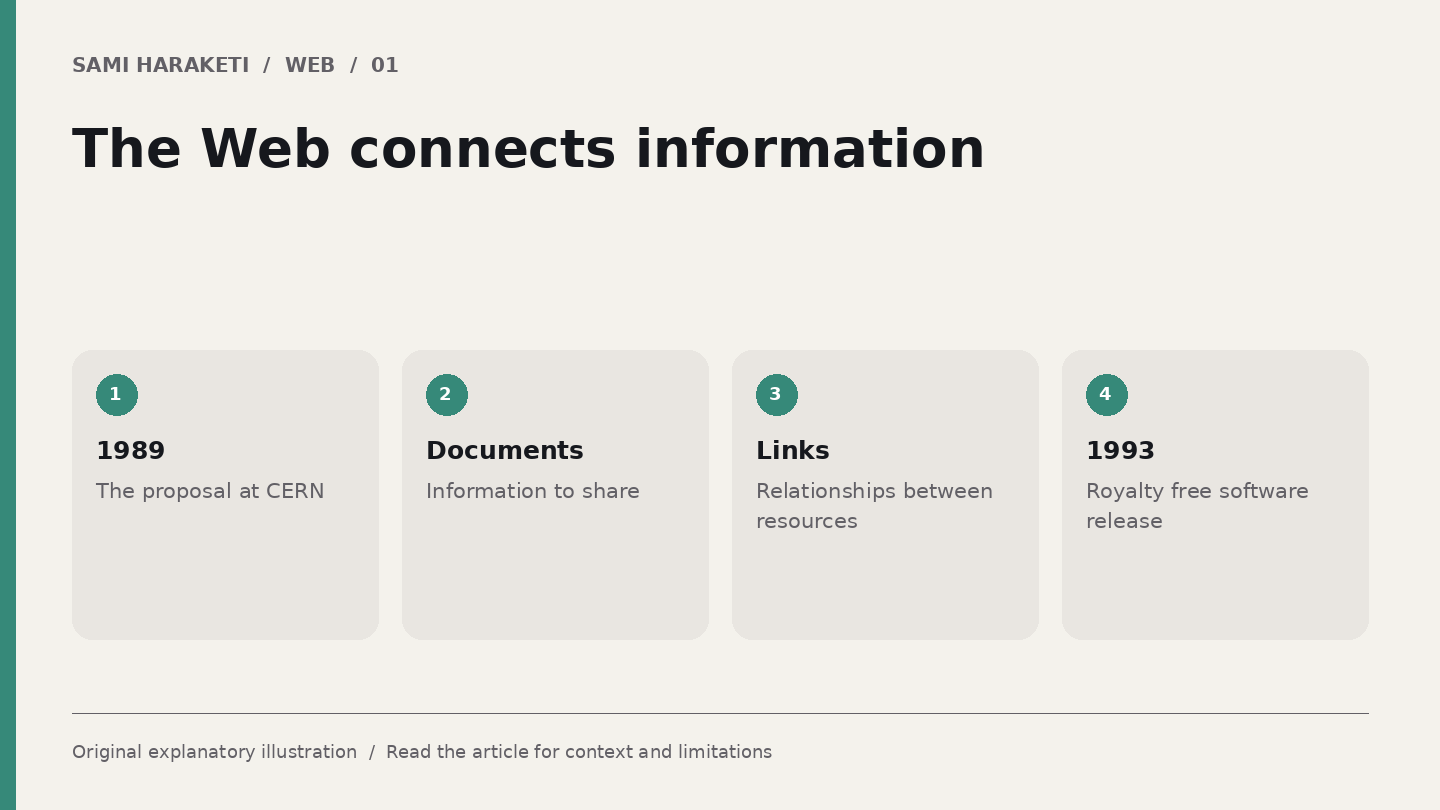
CERN records that Tim Berners Lee invented the World Wide Web in 1989 while working there. The project addressed information sharing among researchers, including people working across different institutions.
The Web is not the same thing as the Internet. The Internet provides network infrastructure; the Web is one system built on it, using linked resources that browsers can access.
CERN's history also records the release of Web software on a royalty free basis in 1993. That openness helped create conditions for wider use.
I do not read this history as an argument that every website should resemble an early document. The visual possibilities have changed enormously. I read it as a reminder that a website becomes useful when it helps someone move from a question to relevant information.
A link is a design decision
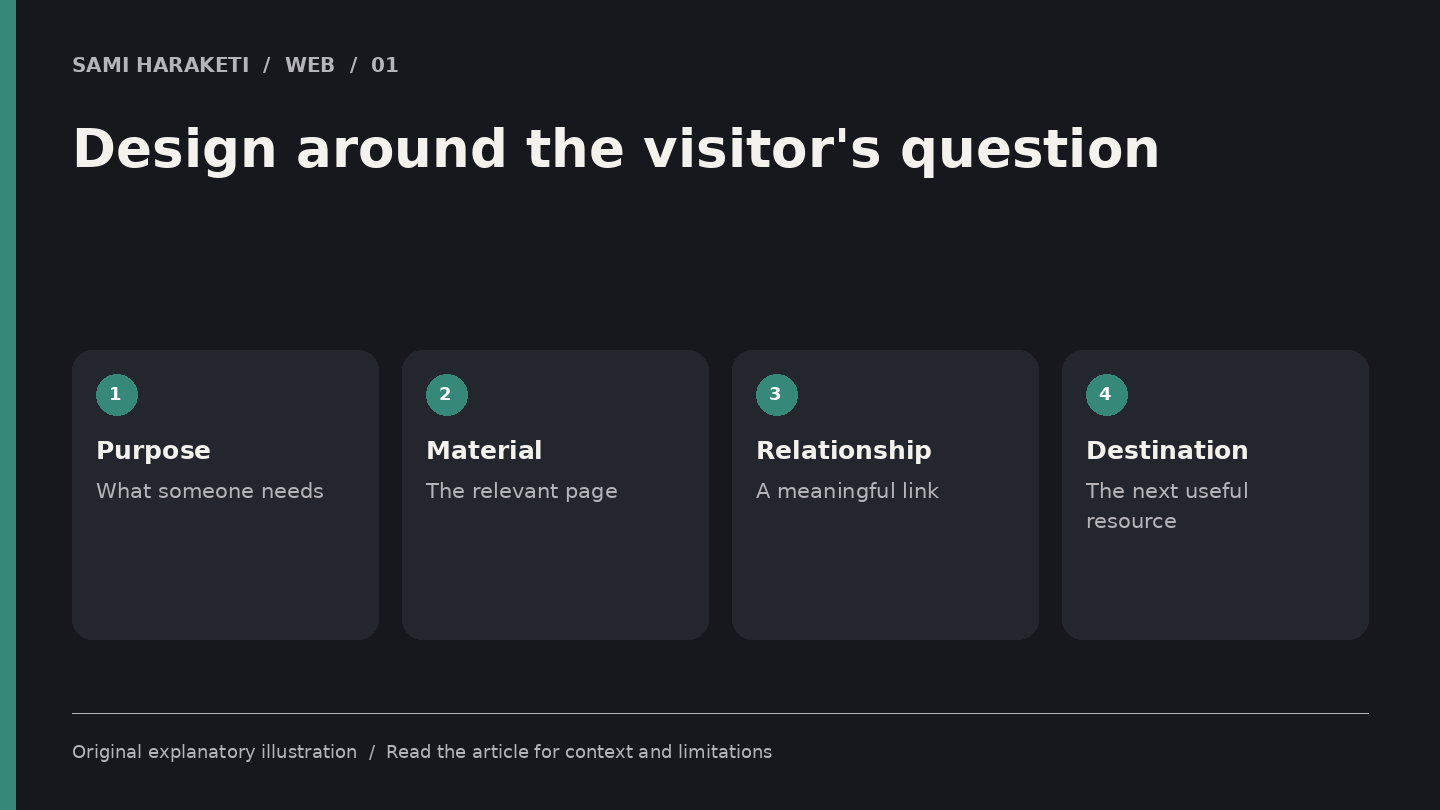
Imagine a fictional research project with reports, partners and public events. A beautiful home page might show an atmospheric film and a large slogan. A visitor may still need to know what the project does, whether a report is available and where an event takes place.
I would write those needs before arranging the page. Then I would make the links describe their destinations. “Read the soil sampling report” gives more information than a row of identical “discover more” labels.
The information also needs relationships. An event should connect to its programme and registration details. A report should connect to its publication date, authors and relevant project information. A partner list should explain what the organisations are contributing where that information is approved.
These are proposed choices for the example project. They do not require filling every page with text. They require placing the right detail at the point where a visitor needs it.
Visual rhythm can still be generous. The structure simply gives that rhythm something useful to carry.
Keep the purpose visible as the site grows
A small website often begins with clear relationships and becomes harder to use as new material accumulates. A report is added without a category. An event remains prominent after it ends. A project page uses an old name.
Before a redesign, map the existing content. Which pages remain useful? Which need updating? Which are duplicated? Which links send people to a dead end?
For our fictional project, I would separate current events from the archive and give published reports a stable route. I would keep old material where it remains useful, with dates and status that make its context clear.
History is helpful here because it pulls the conversation away from novelty alone. The Web's early information sharing purpose remains relevant even when the interface contains video, animation and complex interactions.
A modern website can be expressive and still be a good document system. It can create an impression while helping people find what they came for.
That is the kind of modernity I am interested in: a clear idea made accessible through careful structure, thoughtful links and a visual treatment that belongs to the material.
Sources and further reading
Research checked on October 5, 2026. Original explanatory illustrations by Sami Haraketi, prepared for this article.
Sources and further reading
Research checked on October 5, 2026. Original explanatory illustrations by Sami Haraketi, prepared for this article.
What did you think?
A thought, a different perspective, a little appreciation. You’re welcome here.
.png)