The Alchemy of Grief in Field of Dreams
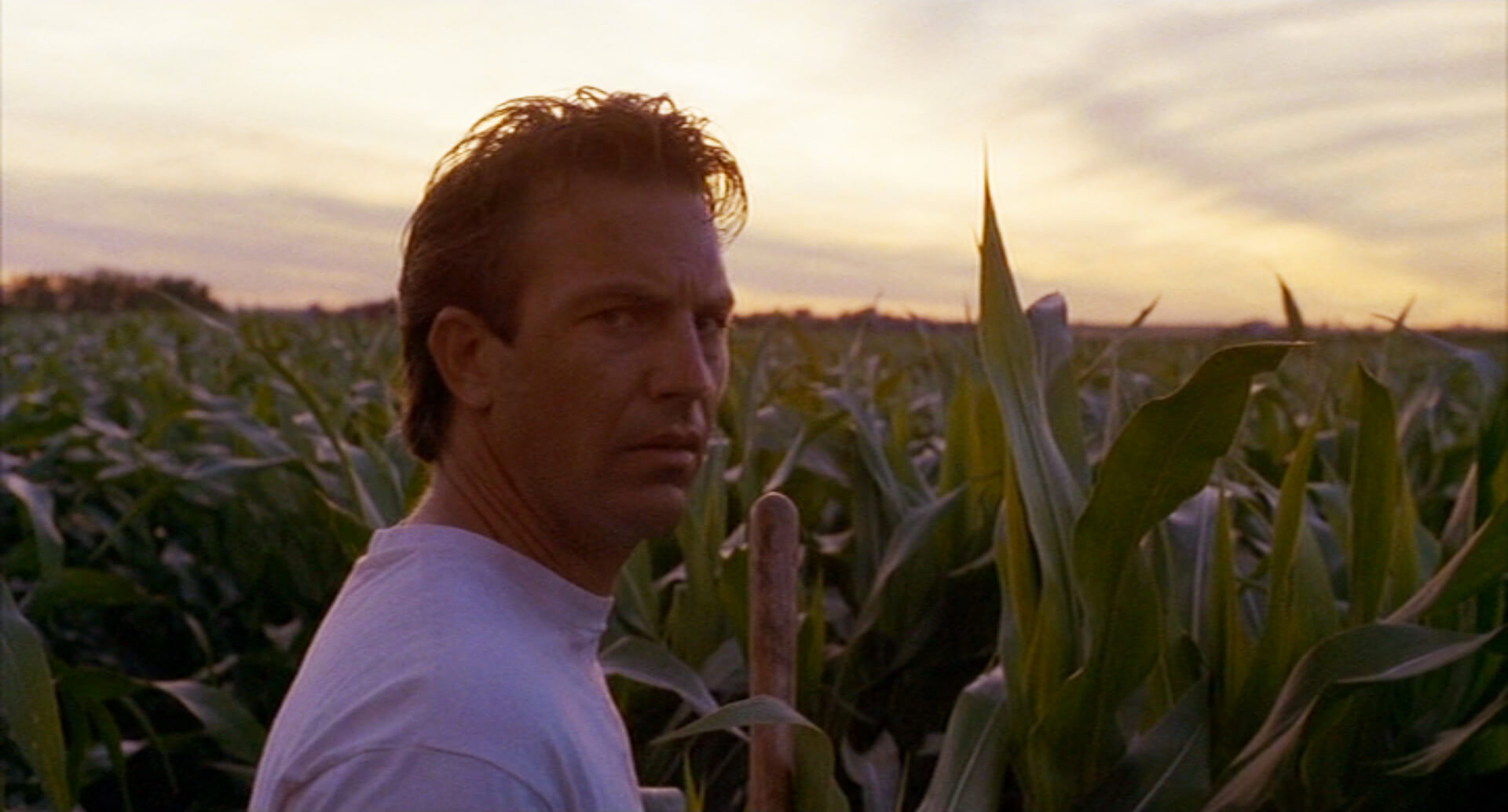
There is a moment in Phil Alden Robinson's Field of Dreams (1989) that functions less like a scene and more like a spiritual event. It arrives after the trials, after the doubting, after a man has driven across the country chasing voices that may only exist in his head. Ray Kinsella (Kevin Costner) stands in the amber glow of his Iowa cornfield, a baseball diamond improbably carved into the crops. Across from him stands a younger version of his father, John Kinsella (Dwier Brown), a catcher for the minor leagues, a ghost pulled from the ether to settle a debt that has nothing to do with money. Ray, his throat tight with a lifetime of regret, offers the simplest of olive branches: "Dad… do you want to have a catch?"
If you are a man, and you have seen this sequence without feeling the hot press of tears behind your eyes, you may be made of sterner stuff than the rest of us or you may simply be lying. The question of why Field of Dreams possesses such a specific, targeted power over its male audience is not merely a matter of sentimentality. It is a question of cinematic architecture. Robinson, working from W.P. Kinsella's novel Shoeless Joe, constructs a narrative that bypasses the critical mind and speaks directly to the subconscious, using the grammar of film editing, music, camera movement, color to build a cathedral of emotion where the central ritual is the reconciliation of a son with his father, and by extension, a man with himself.
This is a film that understands something profound about the male condition: that for so many men, the only way to reach the past, to touch the pain of what was left unsaid with their fathers, is through myth. It understands that masculinity, at its healthiest, is not about stoic silence, but about the quiet, courageous act of building a space where feeling is possible.
This is the cinema of emotional subtraction, where everything unnecessary is stripped away until only the pure, aching core of a relationship remains.

The Voice and The Vision: Establishing the Mythic Register
The film opens not in the world of men, but in the liminal space of a cornfield at night. The camera drifts, almost imperceptibly, through the stalks under a bruised twilight sky. The voice comes not as a roar, but as a whisper, a rustle in the leaves: "If you build it, he will come."
This is a radical act of narrative trust. Robinson asks us to accept the supernatural without explanation, without irony. The voice is treated not as psychosis, but as vocation. Critic Martin McKenzie Murray, writing for The Saturday Paper, notes the film's remarkable cultural insinuation, calling it "12 pounds of sentimentality in a four pound bag," yet acknowledging its power as a text that tells us "plenty about the US" and its relationship with nostalgia. But the film's genius is that it weaponizes this nostalgia. The voice is a siren call to the past, not for the sake of history, but for the sake of healing.
The visual palette established here is crucial. Cinematographer John Lindley bathes the frame in the golden hour, a perpetual magic hour light that suggests a world slightly removed from our own. The greens of the corn are hyper saturated, almost emerald; the skies are a painterly gradient of pink and blue. This is not documentary realism; it is the visual language of memory, the way we want to remember things. The color grading tells us we are in a space where miracles are permissible.
The Leap of Faith: Ray Kinsella as the Reluctant Prophet
Kevin Costner's performance is the film's gravitational center, and it is a masterclass in reactive acting. Costner plays Ray not as a wide eyed visionary, but as a man deeply uncomfortable with his own visions. He furrows his brow, he shuffles his feet, he looks to his wife Annie (Amy Madigan) for validation as if to ask, "Are you hearing this too?"
Robinson's script establishes Ray's motivation through carefully rationed backstory. The fight with his father, the estrangement over his father's hero worship of "that goddamn shoe shine boy" Shoeless Joe these details are dropped like pebbles into a pond. We feel the ripples before we see the stone. The Dramatica story analysis of the film categorizes Ray's throughline as one of "Psychology," with his concern being "Conceptualizing." This is the language of a man trying to make sense of an unreasonable reality. He is a "Be er" in a world of doers, a man who must simply be present to the mystery in order to solve it.
When Ray plows under his corn his livelihood to build the field, the act is rendered with the gravity of a religious conversion. James Horner's score swells here with a rock inflected optimism that is almost giddy. It is the sound of faith taking root.
Amy Madigan's Annie deserves special attention as the film's moral anchor. In a lesser film, she would be the skeptical wife, the obstacle to overcome. Instead, she is the first believer. When the bank threatens to foreclose, when the neighbors mock, when the community turns against them, Annie stands firm. She attends the school board meeting alone and delivers a passionate defense of her husband's madness. Madigan plays this with a fiery intelligence that makes the romance of the film not just about Ray and his father, but about Ray and Annie, a partnership built on trust in the impossible.
The Quest for Meaning: Mann, Graham, and the Intergenerational Chain
The film's midsection functions as a picaresque journey, a road trip into the heart of American mythology. Ray's quest to "ease his pain" leads him to two figures who embody the film's central dialectic.
Terence Mann (James Earl Jones) is the voice of the past as collective memory. Jones delivers his lines with the orotund authority of a prophet descending from the mountain. His famous monologue "They'll come to Iowa for reasons they can't even fathom... It reminds us of all that once was good, and it could be again" is the film's thesis statement on nostalgia. McKenzie Murray critiques this as "nostalgia as cultural pathology," pointing out the inconvenient truths about the era being mythologized. But the film is not naive about this; Mann himself is a cynical, reclusive writer who must be won over. He represents the intellectual's resistance to sentiment, a resistance that is ultimately broken down by the sheer, irrational power of the dream. The film argues that we need the myth despite the facts.
The scene in the Fenway Park concession stand where Ray first encounters Mann is a study in contrasts. Costner, all earnest desperation, bouncing on his heels. Jones, immovable, his voice a low rumble of disdain. Robinson shoots them in tight two shots, forcing them into the same frame, a visual metaphor for the collision of two worldviews. When Mann finally relents, it is not because Ray has convinced him intellectually, but because he senses the genuine ache in the man. It is feeling, not logic, that wins.
Doc "Moonlight" Graham (Burt Lancaster) represents the personal cost of the unlived life. Lancaster, in his final film role, imbues the elderly Graham with a gentle, rueful wisdom. The scene where he steps off the field and back in time to save a choking girl is the film's most explicit statement on sacrifice. The ghostly Graham, given a second chance to play, willingly surrenders it for a human life. It is a sequence edited with surgical precision: the frantic race through town, the handoff of the child, the realization that he cannot go back. The look on Lancaster's face a mixture of loss and peace is devastating. His line, "Son, if I'd only got to be a doctor for five minutes... now that would have been a tragedy," re contextualizes a life of service as its own kind of dream.
Frank Whaley plays the young Graham in the brief flashback, and his few minutes on screen carry the weight of a lifetime. The image of him standing on the threshold of the major leagues, only to be told he will never play, is rendered with a quiet devastation. It is a moment that establishes the stakes for every ghost who will later populate the field.
The Architecture of the Invisible: Editing, Sound, and the Unspoken
Robinson and editor Ian Crafford understood that a film about magic required invisible craftsmanship. The editing is classical, unobtrusive, allowing scenes to breathe and emotions to accumulate. But look closer, and you see the sophistication.
Consider the transition when Ray first hears the voice. He is walking through the corn at night, and Crafford cuts from his puzzled face to a shot of the moon, then back to Ray, who now seems smaller in the frame. It is a subliminal suggestion that forces larger than Ray are at work. The sound design by John Larsen and Cecelia Hall is equally important. The whisper is never over processed; it sounds like a thought, not a special effect. The crack of the bat, when the ghosts first appear, is sharp and clean, a sound from another time, distinct from the ambient noise of the present.
The silence in the film is as carefully composed as the music. After the players disappear into the corn, after Terence Mann ascends, the film goes quiet. The wind rustles. A glove creaks. Robinson holds this silence for an almost uncomfortable length, forcing us to sit with Ray in his loss. Only then does he allow the final scene to begin. This is the mark of a director who trusts his audience to feel without being told what to feel.
James Horner's score is the film's emotional circulatory system. A detailed breakdown on the Film Score Monthly forums reveals that the complete score runs 55 minutes in the film, with Horner employing a "spacious, airy synth" sound for most of the picture, deliberately holding back the full orchestral power. It is not until the final cue, which a fan has titled "People Will Come," that Horner unleashes the orchestra. The music begins gently soft strings, a hesitant piano mirroring Ray's vulnerability. As he asks the question, "Do you want to have a catch?" the music swells, layering in horns and a quiet, pounding percussion. It is a musical release valve for the audience's accumulated emotion.
As one critic on Medium describes it, "The score gradually swells. This shift is significant it mirrors the emotional release the audience feels." This is not manipulation; it is permission. Horner's music gives us license to feel what the stoic images on screen are only implying.
The Climax: Fathers and Sons in the Magic Hour
All of this the voices, the road trip, the ghosts, the speeches is a prelude. The film's true destination is the final ten minutes, a sequence of such refined emotional power that it transcends the medium.
After the vision of the players disappearing into the corn (Mann ascending like Elijah in a chariot of light), Ray is left alone. Then he sees him: a catcher in old fashioned gear, crouched behind home plate. The recognition is not visual but spiritual. Ray knows.
Dwier Brown, as the young John Kinsella, plays the moment with an open, innocent curiosity. He has no memory of his future, no knowledge of the estrangement. He is simply a ballplayer who was given a second chance to play. This creates a profound dramatic irony. Only Ray carries the weight of their shared history; only Ray knows the pain he must atone for.
Robinson's direction here is exquisitely restrained. The camera holds on two shots, allowing the actors' faces to do the work. The editing slows to a near standstill. The sound design drops away, leaving only the whisper of the wind and the creak of leather.
Costner's face in these final moments is a map of suppressed emotion. His jaw tightens. His eyes glisten but do not spill over. He is a man holding himself together by the thinnest of threads, and Costner lets us see every tremor. When he introduces himself to his own father "My name is Ray Kinsella" the formality of it, the heartbreaking necessity of starting over, lands like a blow.
The dialogue is minimalist in the extreme. "Is this heaven?" his father asks. "It's Iowa," Ray replies. The exchange, borrowed from earlier in the film, now carries the weight of a private code. Heaven is not a place; it is a moment of grace between two people who love each other.
The final shot a tracking shot that pulls back and rises, revealing the line of cars, the headlights streaming towards the field is the film's benediction. The pilgrims have come. The field, built for ghosts, now serves the living. It is a shot that combines the epic with the intimate, suggesting that this small act of personal reconciliation has rippled out into the world.
Why Men Weep: The Architecture of Emotional Permission
So, why do men cry at Field of Dreams? It is not simply because it is a story about a father and a son. It is because the film constructs a world where it is safe for men to feel.
The male characters in this film are defined by their longing. Shoeless Joe Jackson (Ray Liotta, playing him as an ethereal, graceful presence) longs to play the game he loves without the stain of scandal. Moonlight Graham longs for a single at bat. Ray's father longed for his son to share his passion. And Ray longs for the chance to say he was wrong. This is a film entirely populated by men who have failed, who have been hurt, and who are given a second chance not through aggression or conquest, but through vulnerability and grace.
The film grants its male characters and by extension, its male audience the dignity of emotional complexity. It suggests that the truest measure of a man is not what he builds, but why he builds it. Ray builds the field not for profit, not for glory, but for the ghost of a relationship.
As one fan on a forum put it, simply and perfectly: "Absolutely." The word is a recognition, a shared understanding. The film creates a community of feeling.
Dwier Brown, who plays the ghost father, wrote in his memoir If You Build It that the film "ends conveniently before the people arrive at the field." He notes that movies can "create this fantasy that doesn't exactly conform to the way people are, and the way laws are, and the way rules are." But perhaps that is the point. The fantasy is not the baseball diamond or the ghosts. The fantasy is that the past can be revisited, that wounds can be healed with a simple game of catch, that a man can look at his father and say, without shame, "I love you."
We cry at Field of Dreams because for two hours, we are allowed to believe that fantasy is real. And in that belief, we are granted a momentary reprieve from the way people are, and the way rules are, and we are given a glimpse of the way things could be again.
In the end, the field is not made of grass and dirt. It is made of longing, and regret, and the enduring, unspoken love between fathers and sons. And we come to it, as Terence Mann said, for reasons we can't even fathom.


More
more
like this
like this
On this blog, I write about what I love: AI, web design, graphic design, SEO, tech, and cinema, with a personal twist.

.png)