Harvey ( 1950 ) is the best movie of all time
There is a moment, about halfway through Henry Koster's Harvey (1950), that captures everything the cinema was ever meant to be. Elwood P. Dowd (James Stewart) stands in the warm glow of a neighborhood bar, a place called Charlie's, where the beer is cold and the jukebox plays something soft. He is talking to a young nurse named Miss Kelly (Peggy Dow), a woman he has just met, a woman who is supposed to be helping commit him to a sanitarium. He does not know this, or perhaps he does and simply does not care. He is telling her about his days.
He explains that he and his friend Harvey "sit in the bars and have a drink or two, play the jukebox. And soon the faces of all the other people, they turn toward mine, and they smile. And they're saying, 'We don't know your name, mister, but you're a very nice fellow.'" He speaks of golden moments, of strangers becoming friends, of hopes and regrets, loves and hates, all very large, because nobody ever brings anything small into a bar. And then, he says, he introduces them to Harvey. "And he's bigger and grander than anything they offer me."
If you have seen this film, you know the feeling that follows. It is not quite laughter and not quite tears, but something better, something rarer: the pure, unadulterated happiness of being in the presence of a man who has figured it all out. Harvey is not merely a comedy. It is a philosophical treatise disguised as a farce, a spiritual meditation dressed in a three-piece suit, a work of such profound and radiant joy that it makes you want to walk out of your own life and into Elwood P. Dowd's. For my money, it is the best movie ever made. And I am going to tell you why.

The Miracle of Mary Chase: From War to Wonder
To understand Harvey, you must first understand its creator. Mary Chase was a relatively unknown playwright in 1944 when she sat down to write a play about a middle-aged bachelor and his imaginary rabbit. The world was at war. America was sending its sons to die on beaches across the Pacific and in the forests of Europe. And Chase, watching from her home in Denver, saw something that would become the seed of the entire work: a neighbor, a woman whose husband and son were both away at war, sitting alone in her house, surrounded by absence .
From that image of loneliness and longing, Chase drew upon the old Celtic mythology of her Irish heritage and conjured the pooka. In Irish folklore, the pooka is a fairy spirit that appears in animal form, always very large, a benign but mischievous creature that delights in chaos and companionship . She called her play Harvey, and when it opened on Broadway in 1944, it became a sensation. It won the Pulitzer Prize for Drama in 1945, making Chase only the fourth woman in history to receive that honor .
What made the play revolutionary was not its humor, though it is very funny. It was the way Chase used that humor to smuggle in profound questions about sanity, reality, and the nature of happiness. Here was a comedy, written in the darkest hours of the twentieth century, that dared to suggest that the sane ones might actually be the mad ones, that the man who drinks too much and talks to an invisible rabbit might be living a richer, truer life than all the respectable people trying to lock him away.
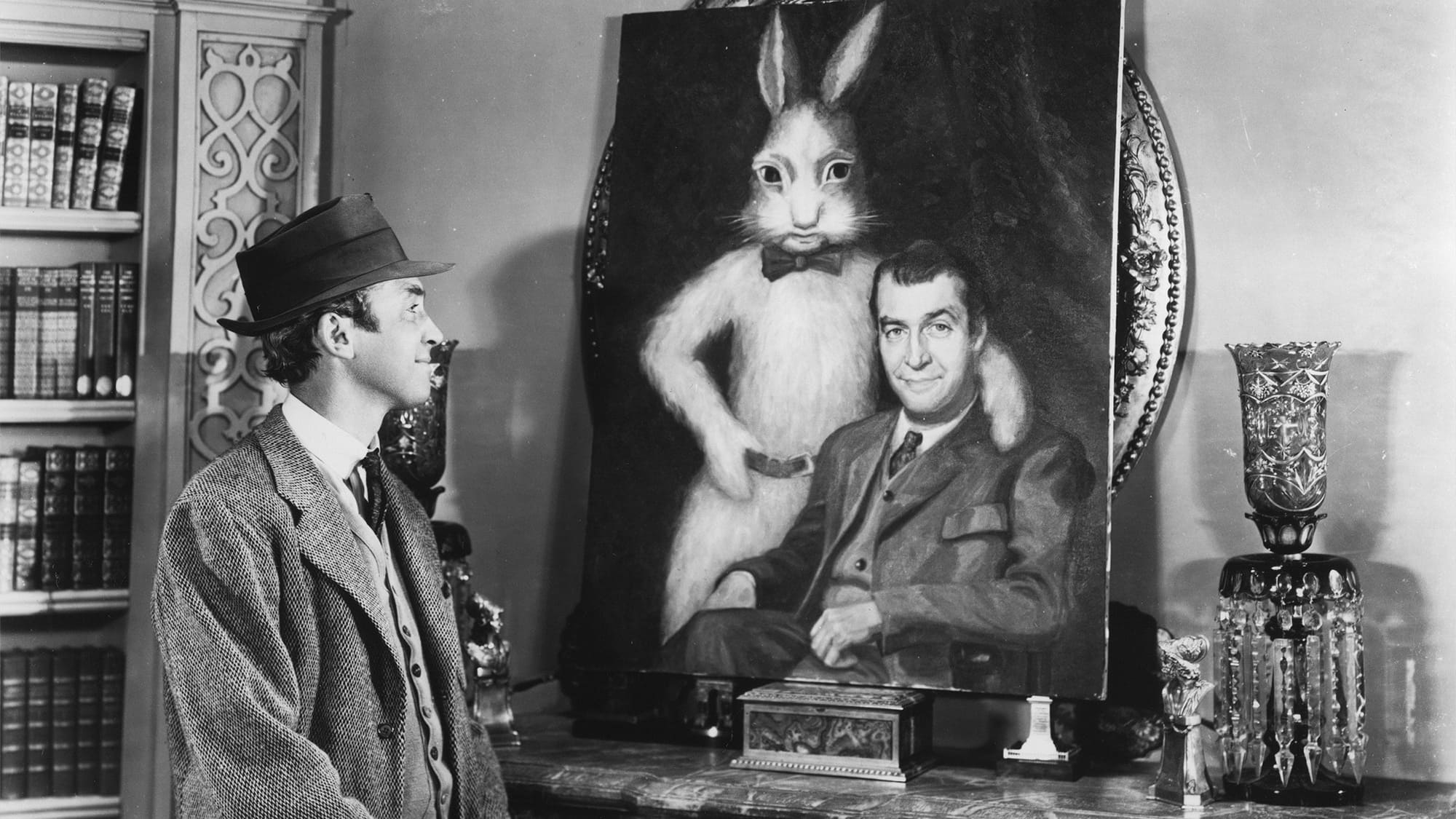
When Universal Pictures brought the play to the screen in 1950, they made a choice that would define the film forever. They cast James Stewart, then at the absolute peak of his powers, fresh off his collaborations with Frank Capra and about to dive into the dark complexities of Hitchcock. Stewart had played the role on stage, and he knew Elwood intimately. He also, in a moment of rare self-criticism, later admitted that he thought he played the part "a little too cutesy, a little too dreamily" in the film version, so much so that he reprised the role on television in 1972 to have "another go" . But to audiences, then and now, Stewart's Elwood is perfection itself: a man who has wrestled with reality for thirty-five years and, as he famously puts it, finally won out over it .
The Architecture of Joy: How the Film Makes You Happy From the First Frame
Let me tell you about the opening of Harvey. The credits roll, and then we see a street, a pleasant American street, with houses and trees and a picket fence. A man walks down the sidewalk. He is tall, lanky, with that unmistakable Stewart gait, all long limbs and easy strides. He pauses at a gate, looks up at the house, and says something. We cannot hear what he says, but we see him gesture to the empty space beside him, as if ushering someone through the gate.
That is it. That is the first frame. And from that moment, you are in.
The film immediately establishes its visual language. Cinematographer William H. Daniels, who had shot Greta Garbo in her prime and would later lens some of the most elegant films of the era, understands that Harvey must be felt before he is seen. The camera is always wide enough to include the invisible presence. It frames two-shots where one side is empty. It moves as if tracking a second person, leaving space, always space, for the six-foot, three-and-a-half-inch rabbit that the audience can never see .
This is the great trick of Harvey. The film never shows you the rabbit. It cannot. As the Portuguese academic journal Revista Minerva points out, when the original play attempted to make Harvey visible, the effect was not convincing. "Materializing it would actually destroy it," the analysis notes. "Harvey exists only as absence and illusion, and bringing him to life would destroy those qualities" . So the film does something far more sophisticated. It creates Harvey through space, through reaction, through the unwavering conviction of its lead actor.
James Stewart once said, "I don't act, I react" . Watch him in Harvey, and you will see what he meant. Every gesture, every glance, every slight tilt of the head is a reaction to a presence that is not there. He looks up, because Harvey is six-foot-eight (Stewart insisted the rabbit be taller than himself, though the script retains the original height of six-foot-three-and-a-half) . He reaches out, he waits, he listens. The performance is a masterclass in imaginary geography, and it works because Stewart commits to it with the same earnest sincerity he brought to George Bailey or Jefferies in Rear Window. He makes you want to believe. He makes you believe.
The supporting cast is equally brilliant, though their approach is entirely different. Josephine Hull, who won the Academy Award for Best Supporting Actress for her role as Elwood's sister Veta, comes from the vaudeville tradition . Her performance is broader, more hysterical, pitched to the rafters in the way of classic screwball comedy. She flutters, she faints, she shrieks. And yet, underneath the comic excess, Hull is playing something genuinely heartbreaking: a woman who has spent her entire life chasing respectability, who has watched her inheritance dwindle and her social standing crumble, all because her brother cannot stop introducing people to his imaginary rabbit.
As one reviewer notes, "Hull had the most difficult role in the film, since she had to believe and not believe in the invisible rabbit at the same time" . She does it brilliantly. Watch her in the scene where she finally breaks down at the sanitarium, confessing that after all these years, she sometimes sees Harvey too. The admission is funny, but it is also tragic. Veta has been fighting Harvey her whole life, and somewhere along the way, she has started to lose.
The rest of the cast forms a perfect ensemble of character actors. Charles Drake plays Dr. Lyman Sanderson, the young, ambitious psychiatrist who falls for the pretty nurse (Peggy Dow, luminous in her innocence). Cecil Kellaway is Dr. William Chumley, the head of the sanitarium, a man trapped in a loveless marriage and his own ego, who finds himself strangely drawn to the rabbit's promise of escape. Jesse White plays Marvin Wilson, the hulking orderly who reads the encyclopedia and discovers, to his horror, that the pooka is "very fond of rumpots, crackpots, and how are you, Mr. Wilson?" . And Wallace Ford, as the cab driver in the final act, delivers one of the film's most memorable lines: "He'll be just a normal human being, and you know what stinkers they are" .
The Philosophy of Pleasant: Elwood P. Dowd as Holy Fool
Let us talk about Elwood P. Dowd himself. On the surface, he is a simple man: middle-aged, unmarried, living off his inheritance, spending his days at the bar with his invisible rabbit. But beneath that surface lies one of the most fully realized characters in American cinema.
We learn about Elwood in fragments, in the quiet moments between jokes. He used to work in an office, he tells us. He used to be smart. He used to keep his head close to the ground, not letting any other thoughts distract him from the business of living . Then his mother died, and something shifted. He started drinking, and somewhere along the way, he met Harvey. He chose to be pleasant instead of clever.
There is a darkness here, and the film does not shy away from it. Elwood is an alcoholic. He admits it freely. His friendship with Harvey began, perhaps, as a kind of escape, a way of numbing the pain of loss and the pressure to conform. But here is the genius of Mary Chase's writing: she takes that darkness and transforms it into something luminous. Elwood's alcoholism is not his flaw. It is his medicine. The drinking, the wandering, the rabbit, these are the tools he uses to stay afloat in a world that wants to drown him in convention.
The film's most famous scene is also its most philosophical. Elwood sits with Dr. Chumley, who has just tried to explain to him that his sister has drawn up commitment papers, stolen his power of attorney, and conspired to lock him away. "Good heavens, man!" the doctor exclaims. "Haven't you any righteous indignation?"
Elwood pauses. He thinks. And then he delivers the lines that should be carved into the walls of every institution that tries to squeeze the wonder out of human beings:
"Oh, Doctor, I... Years ago, my mother used to say to me, she'd say, 'In this world, Elwood, you must be oh so smart or oh so pleasant.' Well, for years I was smart. I recommend pleasant. And you may quote me" .
This is not naivety. It is not stupidity. It is a philosophy, a deliberate choice, a way of moving through the world that prioritizes connection over calculation, kindness over cleverness. Elwood has looked at the smart people, the ones who climb ladders and chase status and never bring anything small into a bar, and he has decided that he does not want to be one of them.
The writer for the academic blog Go Into The Story notes that Chase's great achievement in Harvey is making the protagonist "one of the most lovable characters in film history" while still allowing the other characters to be sympathetic . We never hate Veta, even when she tries to commit her brother. We understand her desperation. We see her social ambitions, her fear of becoming a laughingstock, her exhaustion after years of covering for Elwood's eccentricities. She is not a villain. She is a woman who has been taught that pleasant is not enough, that smart is the only way to survive.
The film's resolution is not a victory of Elwood over Veta, or madness over sanity. It is a reconciliation. In the final scene, as Dr. Sanderson prepares to inject Elwood with a serum that will cure him of Harvey, Veta bangs on the door and stops it. She has listened to the cab driver. She has thought about what her brother would become without his rabbit. And she has chosen pleasant.
As she stands in the hallway, weeping with relief, Elwood puts his arm around her and explains to the others: "Veta's all tired out. She's done a lot today" . It is a line of such gentle understanding that it stops your heart. He is not angry. He is not even disappointed. He simply sees his sister, sees her exhaustion, and offers her the only thing he has ever offered anyone: pleasantness.
The Camerawork of the Invisible: Seeing Without Seeing
Let us talk now about the craft, because Harvey is a film that rewards close attention. Daniels's cinematography is deceptively simple. The lighting in the film divides the world into two realms: the harsh, fluorescent light of the sanitarium, which represents the cold, clinical reality that Veta and Dr. Chumley inhabit, and the soft, moonlit glow of the outside world, where Elwood and Harvey roam free .
Watch the alley scene, where Elwood sits on a crate with Dr. Sanderson and Miss Kelly and tells them the story of how he met Harvey. The moonlight falls on Stewart's face, illuminating him like a saint in a Renaissance painting. There is no irony here, no wink to the audience. He is simply a man explaining his best friend, and the light treats his words with the reverence they deserve.
The camera, too, participates in the illusion. It tracks alongside Elwood as he guides Harvey across a busy street, leaving space for the rabbit that we cannot see . It pans to follow an empty barstool, then cuts to the face of a bewildered patron who has just been addressed by an invisible creature. It frames shots that are deliberately unbalanced, compositions that feel incomplete, as if waiting for a presence that never quite arrives.
This is not gimmickry. It is theology. By refusing to show Harvey, the film forces us to participate in the act of belief. We become, in a sense, like Elwood. We see what we are willing to see. And by the end, if the film has done its work, we see Harvey too.
The Revista Minerva analysis calls this "metafiction," a narrative device that blurs the boundary between the fictional world and the real world of the viewer . When the characters in the film start to see Harvey, when Dr. Chumley sneaks out of his office to meet the rabbit in a cab, when Veta finds her coin purse exactly where Elwood said Harvey would put it, we are not sure whether to laugh or to wonder. Has the film become a fantasy? Or have we, like the characters, succumbed to a collective hallucination?
The answer, of course, is that it does not matter. Harvey is real because Elwood believes he is real. And Elwood's belief makes the world better, warmer, kinder. That is the film's central argument: that reality is overrated, that the things we imagine can be as true as the things we see, that a man with an imaginary rabbit can be saner than all the doctors who want to cure him.
The Comedy of Chaos: Farce, Slapstick, and the Mechanics of Laughter
For all its philosophical depth, Harvey is also a machine of pure comic delight. The plot mechanics, inherited from the play, are those of classic farce: mistaken identities, switched patients, doors slamming, authority figures made ridiculous. When Veta arrives at the sanitarium to commit Elwood and ends up being committed herself, the sequence is staged with the precision of a ballet. The confusion over who is the patient and who is the visitor, the escalating hysteria, the final image of Hull being led away in confusion, it is comedy of the highest order.
The film also knows how to deploy its supporting players for maximum effect. Jesse White's orderly, Wilson, is a masterpiece of deadpan absurdity. When he looks up "pooka" in the encyclopedia and reads the description aloud, only to find that the entry somehow includes his own name, his slow-dawning terror is one of the film's great comic set pieces . The moment is pure surrealism, a breach of reality that suggests that perhaps the universe itself is in on the joke.
Cecil Kellaway's Dr. Chumley provides another rich vein of humor. A pompous, self-important man who has spent his life building a reputation, he is slowly seduced by Harvey's promise of escape. His vision of Akron, where a woman will call him "poor, poor thing" and he will drink cold beer, is both funny and strangely moving . He is a man who has achieved everything society told him to achieve, and all he wants is to be pitied and left alone with his beer.
The film also has a surprising edge, a willingness to go dark that keeps the comedy from becoming saccharine. The critic on the IMDb user review board notes that Elwood's benevolence "masks a life of failure and impotence," and that the character can stand for "the marginalised, the imaginative, those who refuse the bourgeois grind" . There is a hint of tragedy in Elwood, a sense that his pleasantness is a kind of armor, a defense against a world that has not been kind to him.
But the film never dwells on this darkness. It acknowledges it, nods to it, and then moves on, because that is what Elwood would do. He would not wallow in his failures. He would buy you a drink and introduce you to his rabbit and make you feel, for a little while, that everything is going to be all right.
The Legacy: Why Harvey Endures
Harvey was a hit when it was released in 1950, earning $2.6 million in US rentals and securing a place in the cultural imagination that has never dimmed . The American Film Institute ranked it number 35 on its list of the 100 Funniest Films, and number 7 on its list of the Top 10 Fantasy Films . Stewart received an Academy Award nomination for Best Actor, and Hull won for Best Supporting Actress.
But awards and lists are not why Harvey endures. It endures because it speaks to something fundamental in the human spirit. It endures because, in a world that demands we be smart, it reminds us that pleasant is a valid choice. It endures because it suggests that the line between sanity and madness is thinner than we think, and that maybe, just maybe, the mad ones are the ones who have it right.
The film has been adapted for television multiple times, and there have been persistent rumors of a remake, with names like Tom Hanks, Jim Carrey, and John Travolta attached at various points . None of these remakes have materialized, and perhaps that is for the best. Some films are of their moment, and some films exist outside of time. Harvey belongs to the latter category. It is a film that could only have been made when it was made, by the people who made it, with the particular alchemy of Stewart's performance and Hull's hysteria and Daniels's moonlit cinematography.
But the real reason Harvey endures is simpler. It makes you happy. Not in the shallow way of a sitcom or a blockbuster, but in the deep way of art that touches something true. It makes you want to be kinder, more patient, more open to the absurdities of existence. It makes you want to sit in a bar with a friend, any friend, visible or not, and talk about the big terrible things you have done and the big wonderful things you will do.
There is a moment at the very end of the film, after all the chaos has subsided, after the gates of Chumley's Rest have closed, after Elwood has said goodbye to Harvey. He stops, turns around, and has one last conversation with his invisible companion. Harvey, it seems, has already returned from a trip to Akron with Dr. Chumley. Harvey opens the gate for Elwood. And Elwood, that most pleasant of men, walks off into the night with his friend, toward the bus stop, toward Charlie's Bar, toward another drink and another golden moment.
The final credit reads: "Harvey as Himself."
Why This Is the Best Movie Ever Made
I said at the beginning that Harvey is, for my money, the best movie ever made. Let me tell you why.
It is not because it is technically perfect, though it is close. It is not because it is the funniest or the most profound, though it makes a strong case for both. It is because Harvey does something that almost no other film dares to do. It builds a world where kindness is the only currency that matters, where being pleasant is a legitimate philosophy, where a man with an invisible rabbit can be wiser than all the doctors and all the social climbers and all the people who have never brought anything small into a bar.
In a film culture that often rewards cynicism, that celebrates the antihero and the complicated villain, Harvey stands alone. It is a film of radical, unapologetic goodness. It believes that people can change, that families can heal, that the world can be made better not through force or cleverness, but through the simple act of being pleasant.
The film has its dark edges, as I have noted. Elwood is an alcoholic. Veta is a social climber who tries to have her brother locked away. Dr. Chumley is a fraud. But the film's genius is that it does not judge these characters. It sees them, understands them, and offers them the same gift Elwood offers everyone: a chance to be pleasant, just for a moment, just long enough to remember what it feels like.
This is why men cry at Field of Dreams, and it is why everyone with a pulse should be happy watching Harvey. Both films understand that the world is hard, that reality is often disappointing, that the smart people usually win and the pleasant people usually lose. But they also understand that winning is not the point. The point is the golden moments, the friendships, the small acts of kindness that make the whole ridiculous enterprise worthwhile.
So I say to you, whoever you are, wherever you are, if you have not seen Harvey, stop reading this and go watch it. And if you have seen it, watch it again. Sit with Elwood and Harvey at Charlie's Bar. Listen to the jukebox. Let the faces of the other people turn toward yours and smile. Bring something large into that bar, something hopeful, something wonderful. And when you leave, leave impressed.
Because there is a little bit of envy in the best of us, and that is too bad. But there is also a little bit of Elwood. And that is everything.


More
more
like this
like this
On this blog, I write about what I love: AI, web design, graphic design, SEO, tech, and cinema, with a personal twist.

.png)