Miracle in Milan and the Unclassifiable Genius of De Sica
There is a moment in Vittorio De Sica's Miracle in Milan (1951) that stops your heart, though it is played for laughter. The slumdwellers of the shantytown by the Milan railroad tracks have just been evicted by the wealthy landowner Mobbi, their cardboard homes torn down, their few possessions scattered in the mud. Totò, the film's protagonist, watches it all with the same gentle, unshakeable smile he has worn since he was a baby found in a cabbage patch. And then, as the police load the homeless into paddy wagons, a miracle occurs. Or rather, a series of miracles. The prisoners escape. Brooms become flying machines. And the entire community of outcasts rises into the air, soaring over the spires of the Duomo di Milano toward a sun that promises a new world where the salutation "good morning" will mean that the morning is truly good.
This ending confounded critics when the film was released. It confounds them still. For the Spectator in 1954, it was an "outrageously unworthy" betrayal of the neorealist tradition, "a fling against the Church or a vague gesture towards the box-office". For modern audiences, it is something else entirely: the most joyous, the most audacious, the most deeply humanist ending in all of Italian cinema. Miracle in Milan is not a neorealist film. It is not a fantasy film. It is not a comedy, though it is very funny. It is not a tragedy, though it looks unflinchingly at poverty and cruelty. It is all of these things at once: a unicorn in the history of cinema, a work that defies categorization because it answers to a higher law than genre. It answers to the law of goodness.
De Sica himself said it best. In a statement quoted by psychoanalyst Alexander Grinstein in a 1953 essay for American Imago, the director described his film as "a fable suspended half-way between whimsy and reality, a fable that is intended more for grown-ups than for children, but still nothing but a fable". And in the Criterion Collection's essay on the film, De Sica is quoted asking his audience a question that cuts to the heart of everything: "To give life to this film of mine, I tried to find the meaning of a little word that likes to hide everywhere; it is goodness. I beg you to tell me if you find it here in these images, if you recognize it at least here and there."
This is the key to Miracle in Milan. It is a film that does not merely depict goodness. It searches for it. It tests it. It asks whether goodness can survive in a world of oil wells and police battalions, of hunger and humiliation. And it answers, in the end, with a flight over the cathedral, that goodness is not only possible but inevitable, because goodness is the only thing that makes us human.
The Birth of a Fable: From Cabbage Patch to Shantytown
The film announces its intentions from its first frame. The opening credits are superimposed over a detail from Pieter Brueghel the Elder's painting Netherlandish Proverbs, a work dense with folk wisdom and absurdist humor. It is a fitting prelude for a story that will unfold like a fairy tale told by a Marxist with a Chaplin complex.
The tale begins with a baby. An infant is discovered in a cabbage patch, a miraculous origin that the film presents with such straight-faced simplicity that it never feels like whimsy. As Joseph Sgammato notes in his analysis for Senses of Cinema, "The story begins at the beginning, with a new baby miraculously born in a cabbage patch – the European explanation to young children of where babies come from, analogous to the stork theory". The old woman who finds him, Lolotta (Emma Gramatica, a veteran stage actress of extraordinary warmth), raises him with a kindness so pure it seems almost supernatural. When young Totò boils something on the stove and the foam spills over the floor, she does not scold him. She sets up toy trees and little animals next to the greasy spill and pretends it is a river.
This is the film's moral foundation. Lolotta teaches Totò that the world can be remade by imagination, that poverty does not have to mean poverty of spirit. When she dies, the young boy walks behind her hearse through a landscape of vacant lots and fog-shrouded garbage heaps, and the film does not flinch from the desolation. An escaped prisoner joins the procession, using the funeral as cover for his flight. It is a scene that the Prairie Uprising Review calls "redolent of Chaplin", balancing grief with the absurd persistence of life.
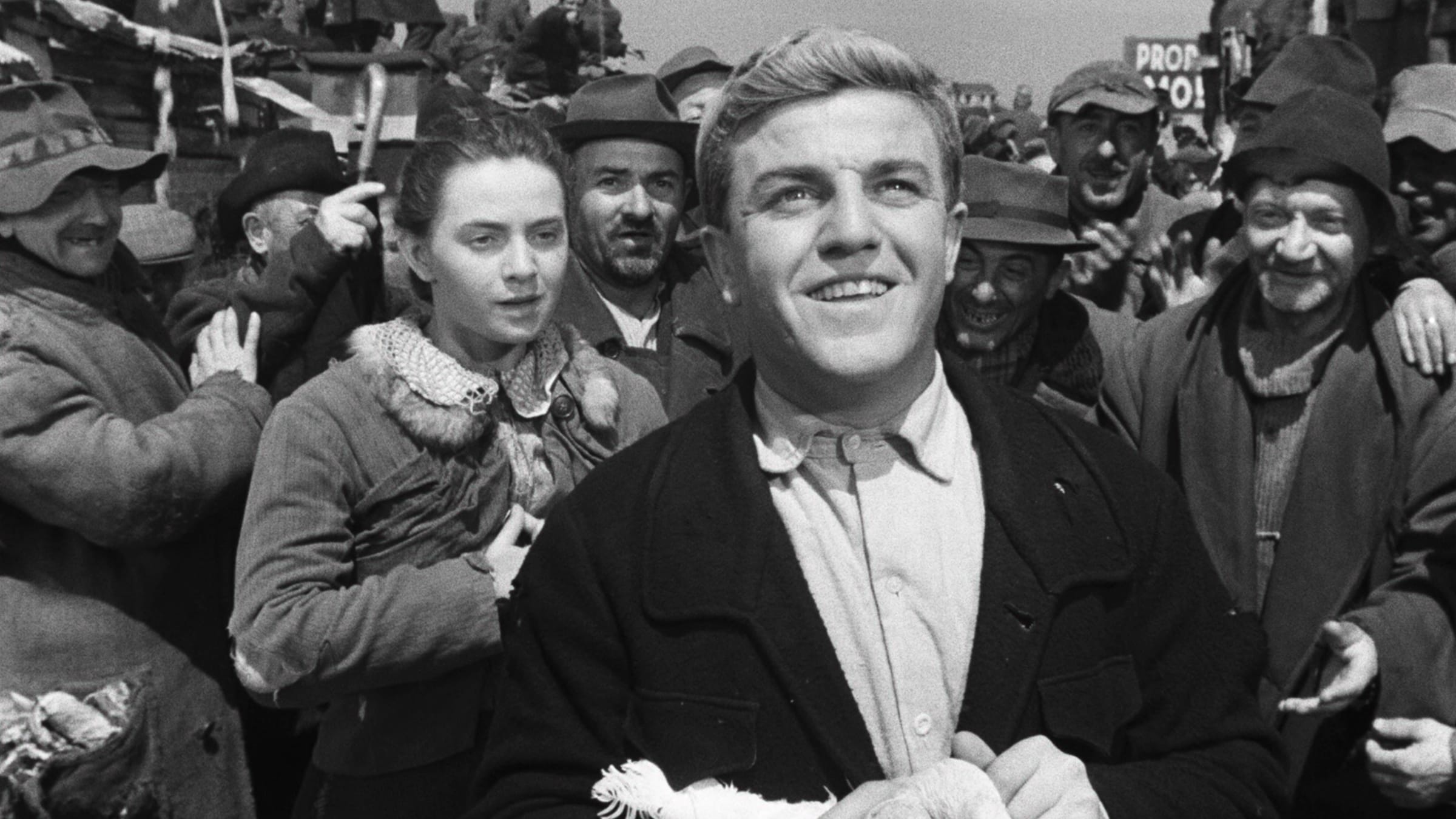
Totò is sent to an orphanage. De Sica dispatches this chapter of his life in a single cut: the boy enters the forbidding institution in one shot and emerges in the next as a young man, still smiling, still unbroken. The actor who plays Totò as an adult is Francesco Golisano, an amateur selected for his ordinary, everyman appearance. He worked in eight or nine films over the course of two years and was retired from the industry by 1952. But in Miracle in Milan, he is unforgettable: a man with a square-cut head and short limbs who moves through the world with the trusting openness of a child. As the Variety review noted at the time, "Performances by pros and tyros alike are flawless".
The Architecture of Community: Building a City of Cardboard
The film's middle section is a documentary-like portrait of postwar poverty rendered with neorealist precision. When Totò leaves the orphanage, his bag is stolen. He chases the thief, confronts him, and then, seeing the man's desperation, lets him keep it. The thief takes him to a makeshift camp by the railroad tracks: a squalid collection of cardboard boxes, scrap metal, and other refuse where the homeless of Milan have gathered to survive.
The cinematography by Aldo Graziati (credited as G.R. Aldo) captures the atmosphere of postwar Milan with unsparing clarity: deserted streets, ruined buildings, a population that has learned to be cold because warmth is a luxury. Horses and carts still run up and down the streets; cars are a rarity except among the filthy rich. When winter comes and the sun rises, the slumdwellers race to the few patches of light that fall between the buildings, desperate for a moment of warmth.
And then something remarkable happens. Totò, with his inexhaustible optimism, begins to organize. He encourages his neighbors to build larger, more elaborate shelters. A village rises on the muddy plain, complete with named streets, a central square, and a disfigured sculpture of a ballerina that becomes its mascot. The film lingers on these creations, on the ingenuity of the poor, on the dignity of people who build a city out of nothing because they have nothing else.
This is where Miracle in Milan departs most radically from the neorealist canon. As the Senses of Cinema analysis notes, the film was produced between two of De Sica and Zavattini's most tragic collaborations, Bicycle Thieves (1948) and Umberto D. (1952). "Among these," Sgammato writes, "Miracle in Milan is unique. The serious – not to say tragic – tone of the remainder of the De Sica–Zavattini quartet is nowhere to be found here, although the luckless poverty and social injustice of the others still abound".
The IMDb reviewer l_rawjalaurence draws connections to other traditions: the musical numbers recall British films like Sing As We Go (1934) and Depression-era Hollywood musicals like 42nd Street (1933), while the group ethic that binds Totò and his friends together echoes the community-building comedy of Passport to Pimlico (1949). But the film transcends these influences. It is doing something new: using the tools of fantasy to amplify reality, not escape it.
The Rise of the Rich: Oil, Greed, and the Machinery of Oppression
The paradise of the shantytown cannot last. When the villagers erect a maypole, they strike an underground oil field. Geysers erupt from the ground, and the oil bursts into flame, painting the gray skies with fire. The land, worthless when it was home to the poor, becomes priceless when it can be exploited.
Enter Mobbi, the landowner, played by Guglielmo Barnabò with the pomposity of a silent film villain. He tries every possible means to evict the squatters: police forces, water cannons, bullets. His offices are decorated with bellicose life-size statues that recall the architecture of fascism. When a deputation of slumdwellers goes to plead their case, they are dismissed with contempt. The rich man's world has no room for the poor man's dignity.
De Sica's social criticism here is pointed but never didactic. As the Douban reviewer notes, the film "does not close its eyes to the sufferings of his fellows". And as De Sica himself said, responding to Italian newspapers that accused the film of inciting class hatred: "I have no interest in politics. I am a member of no party, I am not a propagandist of any ideology. Miracle in Milan is inspired by nothing but a Christian feeling of human solidarity". It is a crucial distinction. The film is not a tract. It is a plea for recognition, a reminder that the poor are not statistics but people, and that their desire for a roof over their heads is not a political demand but a human one.
The Miracle Arrives: Fantasy as Moral Weapon
When all seems lost, the miracle comes. But it comes not from heaven but from memory. The ghost of Lolotta, Totò's adoptive mother, descends from the sky on a cloud. She gives Totò a dove, a magical creature that will grant wishes. The special effects, managed by American technician Ned Mann, are described by one critic as "serviceable but unconvincing". But this misses the point. The dove's unreality is the point. It is not meant to look real. It is meant to feel real, to operate on the logic of dreams and fairy tales, where magic is the only justice the poor can afford.
The subsequent sequence is a masterpiece of slapstick social satire. When Mobbi orders his goons to attack the shantytown, the dove makes them start singing opera arias instead. When fire hoses are deployed against the squatters, a thousand impermeable umbrellas materialize. The villagers discover that the dove will grant their wishes, and for a moment, they ask for fur coats, millions of dollars, chandeliers. One tiny man asks to be made larger. A Black GI pining for an Italian woman asks to be made white. No sooner is this accomplished than the man's girlfriend appears—she has asked to be made Black. The film's humor is not gentle. It is barbed, pointed, aware that the poor are as capable of folly as the rich.
The miracles escalate until Mobbi's forces are routed. But then the dove is lost. The angels—two scrawny figures in leotards who look like something out of Cocteau—snatch it away, perhaps because the poor have become as greedy as their oppressors. The police return. The shantytown is destroyed. And Totò and his neighbors are loaded into paddy wagons and driven to the bleak square next to the Milan Cathedral.
It is here, in the shadow of the Duomo, that the film makes its final, extraordinary leap.
The Flight: Cinema as Liberation
Totò's girlfriend, Edvige (Brunella Bovo), grabs a dove from a chicken coop and gives it to him. It is not the magical dove, but Totò wishes on it anyway. The paddy wagons burst apart. The squatters seize the brooms of workers sweeping the square. And then, in one of the most famous images in Italian cinema, they levitate into the air and fly over the cathedral toward the sun, singing a chorus about the brotherhood of man.
The Spectator critic in 1954 called this ending "a pie in a back-projected sky". It was a common reaction. Neorealism, after all, was supposed to be about reality. It was supposed to show things "exactly as they are," as Zavattini himself had written in his manifesto for the movement. But here was De Sica, the director who had given the world the gut-wrenching realism of Bicycle Thieves, sending his characters flying away on brooms like witches in a fairy tale.
The Criterion Collection essay suggests a different reading. "Today," it argues, "the pertinent question about Miracle in Milan may be not about whether it qualifies as a neorealist film despite its fantastic trappings but about its efficacy, emotionally and aesthetically". By this measure, the ending is not a betrayal but a fulfillment. The realism of the film—the ruined streets, the cardboard shacks, the cold faces of the rich—has been so thoroughly established that the fantasy does not negate it. It transcends it. It offers not an escape from suffering but a transformation of suffering into hope.
De Sica himself explained the film's purpose in terms that cut through the critical debates. "It is an uneven battle," he said of the struggle between rich and poor, "but the pauper, with miraculous cleverness and courage, always succeeds in coming out on top in the end. Most often the force that drives and guides him is love and, in the end, it is goodness that is rewarded and evil that is punished. This is the story which men pass on from generation to generation as a lesson to children and a warning to adults".
The Structure of a Dream: Narrative as Wish Fulfillment
Psychoanalyst Alexander Grinstein, in his 1953 essay for American Imago, offered a reading of the film that illuminates its peculiar power. "During the entire film," he wrote, "a certain aura or quality persists which may be best described as definitely dreamlike. The rapid shifting of scenes, the magical wish fulfillment of the miracles in which all the wishes of the populace are granted, the ridiculousness of some situations"—all of these, Grinstein argued, create a work that operates on the logic of the unconscious.
This is not to say that the film is merely a fantasy. It is to say that its structure mirrors the way we process reality in our deepest selves. The rapid transitions, the sudden appearances of ghosts and angels, the way the film moves from gritty documentary to slapstick to opera to fairy tale without ever losing its emotional coherence—all of this creates a world that is not real but feels more true than reality. It is the world as it should be, seen through the eyes of a man who has chosen goodness over cleverness.
The film's unique structure drew criticism at the time. The Spectator declared that "neorealism is dead!" in the wake of Miracle in Milan, arguing that De Sica had abandoned the rough edges that gave the movement its power. But the same critic acknowledged that De Sica retained his stature as a director, even as others faltered. And in retrospect, the film's hybridity looks less like a betrayal and more like an expansion. As the Douban reviewer puts it, "On the basis of neorealist aesthetics, grafting on something else is also a kind of attempt, or a breakthrough".
The Performances: Professionals and Non-Professionals in Harmony
One of the defining characteristics of Italian neorealism was the use of non-professional actors. De Sica had pioneered this approach in Bicycle Thieves, casting a factory worker as the protagonist. In Miracle in Milan, he repeated the trick with Francesco Golisano as Totò, but he also surrounded his amateur lead with a constellation of professional character actors.
Emma Gramatica, who plays Lolotta, was a legendary stage actress nearing the end of her career. Her performance is the film's moral anchor: a woman whose kindness is so absolute that it survives her death and returns as a ghost to save her adopted son. Guglielmo Barnabò, as Mobbi, plays villainy with a comic broadness that never tips into caricature; he is ridiculous, but he is also genuinely menacing. Paolo Stoppa, who appears as a minor character, would go on to a long career in Italian cinema.
But it is Golisano who holds the film together. His Totò is a creation of extraordinary purity. He is not clever. He is not strong. He is not, in any conventional sense, heroic. He is simply good. And the film insists, against all the evidence of the world, that goodness is enough. As the Prairie Uprising Review notes, "It's notoriously hard to portray goodness and happiness on film—the medium thrives on violence and discontent. De Sica makes an effort at devising a movie about contemporary affairs that isn't cynical and that espouses a faith in the virtue of the common man".
The Cinematography of Two Worlds: Graziati's Mastery
The cinematography of Miracle in Milan is the work of Aldo Graziati, one of the great Italian cameramen of the postwar era. Working with De Sica, he created a visual language that shifts fluidly between the gritty realism of the shantytown and the heightened unreality of the fantasy sequences.
The location work in Milan is shot with a documentarian's eye: the ruins of the war still visible, the streets empty and cold, the faces of extras who look like they have lived through what the film is depicting. When the film moves into fantasy, the style shifts. The lighting becomes more theatrical, the compositions more precise. The final flight over the Duomo is shot with a lyricism that feels almost religious, as if the camera itself has learned to believe.
As the IMDb reviewer observes, "The set design and location work is indelible". The shantytown is one of the most memorable sets in all of cinema: a city of cardboard and corrugated metal, with towers and ramparts and geysers of flame erupting from the ground. It is a place that exists somewhere between reality and imagination, a physical manifestation of the film's central theme: that the poor can build a world, even if the rich will try to take it away.
The Music of Hope: Cicognini's Score
Alessandro Cicognini, who had scored Bicycle Thieves and would go on to score many of De Sica's later films, provides the music for Miracle in Milan. His score is notable for its optimism. As the IMDb reviewer notes, "The musical numbers (by Alessandro Cicognini) attest to a bright future for the poor; not that they need much. They would be happy with just a crust of bread and a roof over their heads".
The music shifts with the film's mood. In the early sections, it is playful, almost vaudevillian, supporting the Chaplin-esque comedy of Totò's adventures. As the film darkens, the score becomes more restrained, letting the images speak for themselves. And in the final flight sequence, it swells into something approaching an anthem, a chorus that seems to speak for the poor themselves as they sing about brotherhood and rise toward the sun.
The Legacy: What De Sica Wrought
Miracle in Milan won the Grand Prize at the Cannes Film Festival in 1951, sharing the honor with Miss Julie and Miracle in Milan itself. It was a controversial choice. The neorealist purists were appalled. But the film found its audience, and over the decades, it has found its place.
Liv Ullmann, the great Norwegian actress and director, has spoken of the film's impact on her. "Somehow it almost changed my life," she said. "I wanted to be part of the world, part of doing something in the world—it made me want to be a good person. It really told me it's important to live, it's important what you do." She added, "I saw it [as] a child". It is a telling detail. The film that confounded critics as a betrayal of realism spoke to a child in the language of fable, and that child became an artist.
Isabella Rossellini, the daughter of Roberto Rossellini and Ingrid Bergman, has also named Miracle in Milan as a particular favorite. The Prairie Uprising Review notes this as "sufficient endorsement, I think, for anyone".
Why This Is the Best Film by One of the Best Filmmakers
Vittorio De Sica made many great films. Bicycle Thieves is often called the greatest film ever made. Umberto D. is a masterpiece of humanist cinema. Shoeshine broke ground for neorealism. But Miracle in Milan is something else. It is the film where De Sica allowed himself to dream.
The director who was born to wealth and lost it, who was a matinee idol in the 1920s and 1930s, who felt "very low in mind" playing the irresistible lover when all he craved was old age, who turned to directing to find meaning—this man understood poverty not as an abstraction but as a wound. He also understood that the poor are not merely victims. They are people. They laugh. They dream. They build cities out of cardboard. And sometimes, if they are lucky, they fly.
The film's final image is not of the poor triumphant. It is of the poor rising. They are not conquering the rich. They are leaving them behind. They are going to a place where the salutation "good morning" will mean that the morning is truly good. It is not a political program. It is a prayer. And it is the only ending that could have been worthy of everything that came before.
De Sica's biographers note that he was often asked to explain the film. He rarely did. Instead, he returned again and again to the same word: goodness. "To give life to this film of mine," he said, "I tried to find the meaning of a little word that likes to hide everywhere; it is goodness". He was not being coy. He was being precise. Miracle in Milan is a film about goodness: its fragility, its power, its necessity. It is a film that believes, against all evidence, that goodness can win. Not because the world is good, but because goodness is the only thing that makes the world worth living in.
In the end, the miracle of Miracle in Milan is not the dove. It is not the flight over the Duomo. It is not the broomsticks or the angels or the singing policemen. The miracle is Totò himself. A man who was found in a cabbage patch, raised in an orphanage, and spent his life among the poor. A man who smiled when the world told him to despair. A man who built a city out of cardboard and believed, with every fiber of his being, that the morning could be good.
That is the miracle. And it is one that De Sica offers to us, his audience, as a gift and a challenge. "I beg you to tell me," he said, "if you find it here in these images, if you recognize it at least here and there".
Look. It is there. In every frame. In every smile. In every cardboard house and every flight over the cathedral. Goodness is there. And if you recognize it, you have understood the film. And perhaps, just perhaps, you have understood a little bit more than that


More
more
like this
like this
On this blog, I write about what I love: AI, web design, graphic design, SEO, tech, and cinema, with a personal twist.

.png)