Japanese American in US Concentration camps
On February 19, 1942, President Franklin Delano Roosevelt signed Executive Order 9066. It was one of the most consequential documents in American history—and one of the most shameful.
The order authorized the Secretary of War and military commanders to designate "military areas" from which "any or all persons may be excluded." It did not mention Japanese Americans by name. It did not need to. The target was understood by everyone who read it .
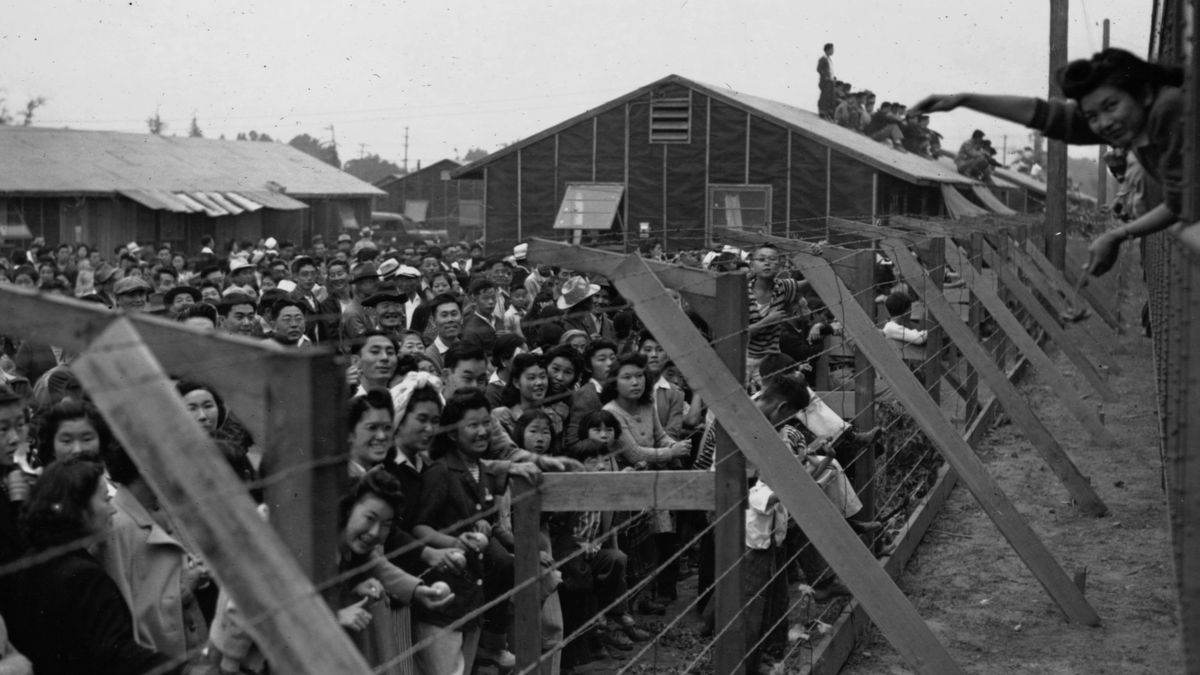
In the weeks and months that followed, more than 120,000 people of Japanese ancestry—approximately two-thirds of them American citizens, born in the United States—were removed from their homes on the West Coast. They were given days to prepare. They were told to pack what they could carry. They were then transported to makeshift detention centers and, ultimately, to remote prison camps surrounded by barbed wire and guarded by armed soldiers .
They had committed no crimes. No charges were filed. No trials were held.
This is the story of what happened. It is based entirely on verified historical records, government documents, and the words of those who lived through it.
I. The Order
December 7, 1941. The Japanese military attacked Pearl Harbor. More than 2,000 American service members died. The following day, President Roosevelt addressed a joint session of Congress. His words have been preserved in the Library of Congress: "December 7, 1941—a date which will live in infamy" .
The attack ignited a wave of fear across the United States. It also ignited something else: a long-simmering racial prejudice against people of Japanese ancestry that had been building for decades.
Before the war, Japanese immigrants and their children had faced systematic discrimination. The Immigration Act of 1924 banned all immigration from Asian countries—a policy that remained in place until 1965 . In California, alien land laws prohibited Japanese immigrants from owning property. They were confined to ethnic enclaves, denied citizenship, and treated as perpetual outsiders no matter how long they had lived in the country or how many of their children were born on American soil.
After Pearl Harbor, this prejudice found new expression. Rumors spread of espionage, of sabotage, of Japanese Americans signaling Japanese submarines from the coast. The rumors were false. The Federal Bureau of Investigation, led by J. Edgar Hoover, did not consider Japanese Americans a threat . The FBI had already arrested thousands of Japanese immigrants it deemed potentially dangerous—and found no evidence of a conspiracy.
It did not matter.
On February 19, 1942, Roosevelt signed Executive Order 9066. The order did not use the words "Japanese" or "Japanese American." But its application was clear. It gave the military the power to exclude "any or all persons" from designated areas—and the designated areas were the West Coast, home to the vast majority of Japanese Americans .
Historians have been unequivocal about the motive. A government-appointed commission that later investigated the internment concluded that it was the result of "race prejudice, war hysteria, and a failure of political leadership"—not military necessity .
II. The Removal
The process began almost immediately.
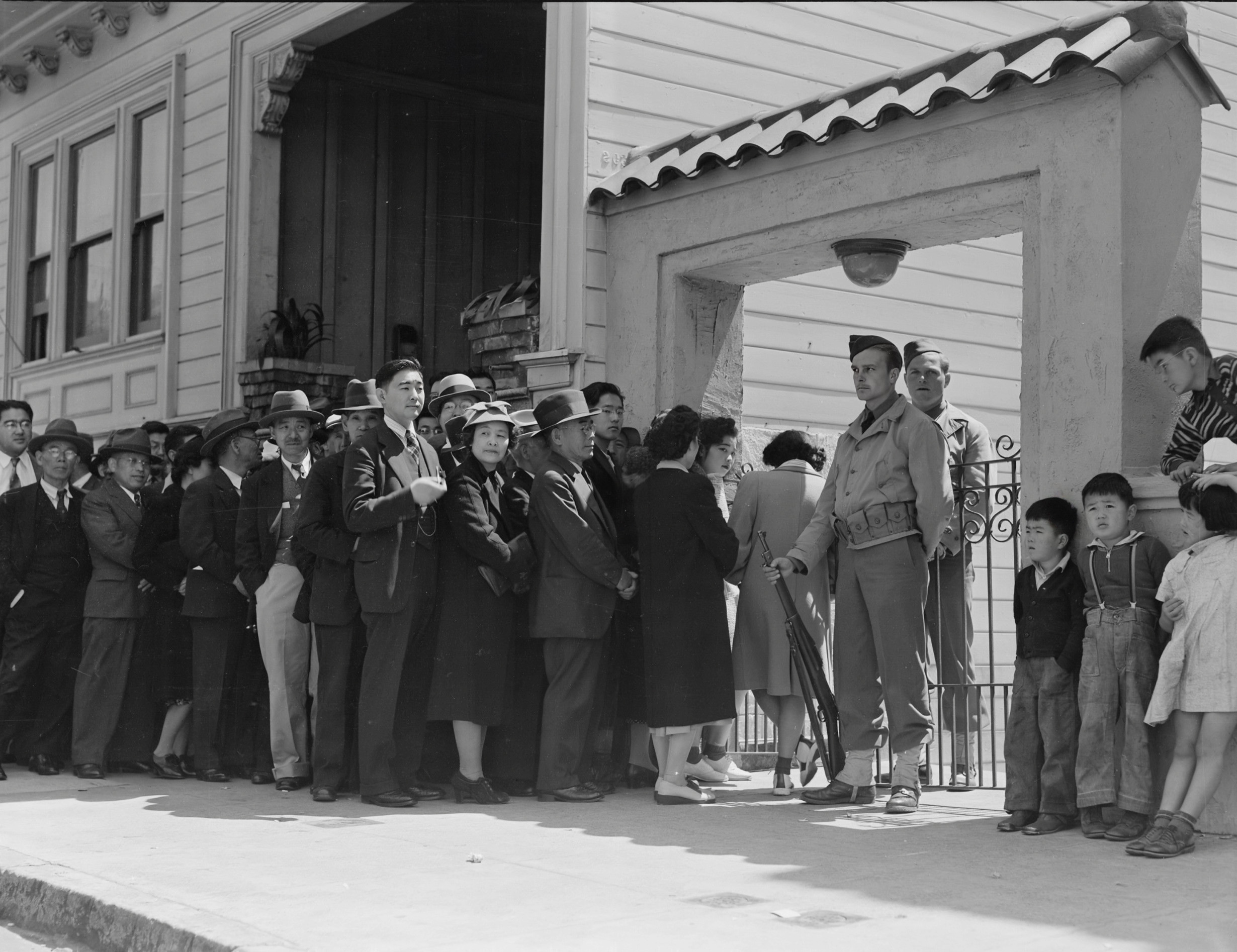
Families were given as little as 48 hours to report to assembly centers. They could bring only what they could carry. They left behind homes, businesses, farms, and everything they had built over decades. Many were forced to sell their possessions at prices far below their value—or simply abandoned them. A 1944 photograph from the Seattle Times shows Gordon Hirabayashi, a University of Washington student who would later become one of the most famous resisters of the policy, in a portrait taken at the time of his arrest .
The first stop for most was one of seventeen so-called "assembly centers." The majority were in California, with others in Oregon, Arizona, and Washington. These were makeshift facilities: former fairgrounds, horse tracks, and racetracks converted into temporary prisons. Families lived in horse stalls, in hastily constructed barracks, in conditions that ranged from cramped to unsanitary .
At the Tulare Assembly Center in California, which operated from April 20 to September 4, 1942, internees published their own newspaper, the Tulare News, documenting activities, sports, and living conditions . At the Turlock Assembly Center, open from April 30 to August 12, 1942, the newspaper was called the Turlock TAC . At the Sacramento Assembly Center, the Walerga Wasp served the same purpose . These publications were produced by people who had been stripped of their freedom, recording their own history even as it unfolded.
From the assembly centers, the internees were moved to what the government called "relocation centers"—a term that belied the reality of what they were. They were prisons. They were concentration camps. They were places where American citizens were held without charge, without trial, without due process of law .
Ten permanent camps were established across the country :
- **Gila River** and **Poston** in Arizona
- **Granada** (also known as Amache) in Colorado
- **Heart Mountain** in Wyoming
- **Jerome** and **Rohwer** in Arkansas
- **Manzanar** and **Tule Lake** in California
- **Topaz** in Utah
- **Minidoka** in Idaho
Each camp was remote, located in deserts, swamps, or barren plains far from population centers. Each was surrounded by barbed wire and guarded by armed soldiers in watchtowers. Families lived in barracks divided into cramped single rooms. They shared communal mess halls, latrines, and laundry facilities. Privacy was nonexistent .
The conditions varied by location but were uniformly difficult. In Utah, as many as 11,000 people were sent to the Topaz camp in the north central part of the state . In Arkansas, families from Southern California found themselves in the swamplands of Rohwer, where children played with crayfish and snakes—a fantastical, disorienting experience for those who had grown up in cities .
The camps were administered by the War Relocation Authority, a federal agency created specifically for this purpose. The official terminology was careful: "relocation centers," "evacuation," "assembly." But the people inside knew what they were. "Concentration camps" was the term many used, then and now .
III. The Numbers
The scale of what happened can be quantified.
**120,000** people were removed from their homes and incarcerated .
Of these, approximately **two-thirds—about 80,000—were American citizens by birth** . The remainder were resident aliens—mostly Issei, the first generation of Japanese immigrants who had been barred from naturalization by law.
They were held for an average of **three years** . The last camp closed on **November 30, 1945**, nearly four months after Japan surrendered .
The economic losses were staggering. According to research cited by Smithsonian Magazine, the internment destroyed an estimated **$3.64 billion** in wealth (in today's dollars) that Japanese Americans had accumulated over decades. Their businesses were taken over by people eager to profit from their misfortune. Many were forced to sell property at bargain-basement prices .
**Not a single Japanese American was ever charged with or convicted of espionage or sabotage during World War II** .
IV. The Resistance
The popular image of Japanese Americans during World War II is one of passive acceptance—quiet people going quietly to camps, enduring their fate without complaint. This image is wrong.
From the beginning, some resisted.
**Fred Korematsu** was a 23-year-old shipyard worker in Oakland, California, when the exclusion orders came. He refused to go. He changed his name, altered his facial features, and went into hiding. He was arrested on a street corner in San Francisco for remaining in a restricted area. His case went to the Supreme Court .
**Gordon Hirabayashi** was a student at the University of Washington. He deliberately violated the curfew imposed on Japanese Americans and refused to report for evacuation. He argued that the government was violating the Fifth Amendment by restricting the freedom of innocent people. He was arrested, convicted, and spent several months in the King County jail in Washington, refusing bail because accepting it would have meant being sent to a relocation center .
**Minoru Yasui** was an attorney in Portland, Oregon. He had volunteered for military service after Pearl Harbor and was rejected because of his Japanese ancestry. He deliberately violated the curfew in his native city, stating that citizens have the duty to challenge unconstitutional regulations .
All three lost their cases. The Supreme Court upheld the convictions of Hirabayashi and Yasui in June 1943. In December 1944, the Court ruled against Korematsu in a 6-to-3 decision. Justice Hugo Black, writing for the majority, included a passage that has been debated ever since:
"It should be noted, to begin with, that all legal restrictions which curtail the civil rights of a single racial group are immediately suspect. That is not to say that all such restrictions are unconstitutional. It is to say that courts must subject them to the most rigid scrutiny. Pressing public necessity may sometimes justify the existence of such restrictions; racial antagonism never can" .
Black then argued that military necessity justified the exclusion. The three dissenting justices—Frank Murphy, Robert Jackson, and Owen Roberts—were scathing. Murphy called the exclusion "the legalization of racism" .
Resistance also took the form of draft refusal. More than 300 internees refused to be drafted into the military until their constitutional rights as citizens were restored. Their argument was simple: If their loyalty was in question, why were they being drafted? If they were citizens entitled to fight and die for their country, why were they and their families imprisoned without charge?
At least two federal judges agreed. Judge Louis Goodman dismissed charges against 26 resisters from the Tule Lake Segregation Center, saying in his decision: "It is shocking to the conscience that an American citizen be confined on the grounds of disloyalty and then while so under duress and restraint, be compelled to serve in the Armed Forces or prosecuted for not yielding to such compulsion" .
Some 100 resisters from the Poston Relocation Center were fined one cent each, the judge deciding that the imprisonment of the relocation center itself was sufficient punishment . Others were not so fortunate. Young draft resisters from the Heart Mountain camp were sent to the McNeil Island Federal Penitentiary in Washington. Older men were sent to Leavenworth Federal Penitentiary in Kansas .
There was resistance in the military, too. In March 1944, 106 Nisei soldiers at Fort McClellan in Alabama refused to undergo combat training while their families were held behind barbed wire without trial. Twenty-eight were court-martialed and sent to Leavenworth with sentences from five to thirty years .
The draft resisters were pardoned by President Harry S. Truman in 1947. But the question they raised—whether citizens must prove loyalty when their rights have been revoked—has never been fully resolved .
V. The Other Camps
The ten War Relocation Authority camps were not the only sites of confinement.
The Department of Justice operated its own internment camps for enemy aliens—including Japanese immigrants who had been arrested in the days after Pearl Harbor. These camps, such as Camp Livingston in Louisiana, held over 1,000 men of Japanese ancestry between 1942 and 1943. The facility, famous as a site for the Louisiana Maneuvers, holds a darker and less well-known history. The men there were held in the pine forests of central Louisiana, separated from their families, their cases reviewed by boards that often deemed them no threat—and yet kept them imprisoned anyway .
There were also federal prisons. Over a hundred Japanese Americans who challenged the internment were convicted and sentenced to terms in federal prisons . Gordon Hirabayashi served part of his sentence at the Catalina Federal Honor Camp in Arizona, a facility in the Santa Catalina Mountains northeast of Tucson where some 45 Japanese American draft resisters were also sent. They arrived in leg irons under armed guard—a contrast to Hirabayashi, who had to hitchhike from Seattle to Tucson to serve his sentence .
Ironically, security at the Catalina Honor Camp was far less stringent than at the relocation centers. Instead of fences and guard towers, the perimeter was marked by white painted boulders. The inmates broke rocks with sledge hammers, cleared trees, and drilled holes for dynamite for road work. They also worked to maintain the camp, grow food, and cook for the prison population. Some of the structures they used—concrete slabs, a basketball court, shuffleboard courts, the remains of a mess hall and kitchen—are still visible today as archaeological features documented by the National Park Service .
VI. The End
On December 17, 1944, the U.S. Army's Western Defense Command issued Public Proclamation No. 21. It rescinded the West Coast exclusion orders and restored the right of Japanese Americans to return to their former communities. The proclamation went into effect on January 2, 1945 .
It took years for all the camps to close. The last closed on November 30, 1945 .
When the internees returned to the West Coast, they found little waiting for them. Their homes had been sold. Their businesses had been taken over. Their communities had been dismantled. Many had nothing to return to.
In 1948, Congress passed a law allowing internees to file claims for property losses. The process was slow, the compensation inadequate .
For decades, the government did not apologize. For decades, the history was minimized, the language sanitized. "Relocation centers." "Evacuation." Words that obscured what had actually happened: the imprisonment of American citizens without charge or trial.
VII. The Apology
The fight for redress took more than forty years.
In the 1970s and 1980s, a movement grew among Japanese Americans to demand acknowledgment and compensation. They were led, in part, by people who had been in the camps as children and had grown up to become political leaders.
Norman Mineta was one of them. His family had been forced from their home and sent first to a racetrack, then to the Heart Mountain camp in Wyoming. He was ten years old. Decades later, he was elected to Congress from California. He spearheaded the fight for redress, pushing for a government apology and financial restitution for nearly a decade .
The opposition was fierce. Fellow lawmakers asked why they should still be talking about something that happened over forty years ago. Mineta would ask them in response: Would they willingly confine themselves behind bars for the duration of World War II for any amount of money? "Most people would say absolutely not," he recalled .
In 1980, Congress established the Commission on Wartime Relocation and Internment of Civilians. The commission held hearings across the country, taking testimony from more than 750 witnesses. Its conclusion was unequivocal: the internment was not justified by military necessity. It was the result of "race prejudice, war hysteria, and a failure of political leadership" .
In 1988, President Ronald Reagan signed the Civil Liberties Act. The law acknowledged, apologized, and made restitution for "the fundamental injustice of the evacuation, relocation, and internment of Japanese Americans during World War II" .
The law provided $20,000 to each surviving internee. It required that applicants be alive on August 10, 1988; be U.S. citizens or permanent resident aliens during the internment period (December 7, 1941 to June 30, 1946); be of Japanese ancestry or the spouse or parent of a person of Japanese ancestry; and have been evacuated, relocated, interned, or otherwise deprived of liberty or property as a result of federal government action based solely on Japanese ancestry .
On September 10, 1998, Attorney General Janet Reno announced the successful completion of the redress program. Over ten years, the Office of Redress Administration had paid more than $1.6 billion to 81,974 individuals .
At a ceremony marking the occasion, Reno said:
"This was a tragic time in our nation's history—a time when we forced people from their homes based solely on their race. There were no trials, no due process, and no justice. For the past ten years, we have sought to right this wrong" .
The checks were distributed at ceremonies across the country. At one, Norman Mineta watched as elderly recipients—some frail, some in wheelchairs—received their payments. He had fought for this for nearly a decade. He thought of his own family, of the racetrack, of Heart Mountain. He told the History Channel:
"The country made a mistake, and admitted it was wrong. It offered an apology and a redress payment. To me, the beauty and strength of this country is that it is able to admit wrong and issue redress" .
VIII. The Legacy
The redress was historic. It was the first time the United States had paid reparations to its own citizens for a government wrong. But it could not undo what had been done.
For the people who had been in the camps, the effects lasted a lifetime. Karen Kurotsuchi Inkelas, a professor of education at the University of Virginia, was born after the war. Her parents had been incarcerated as children—her father in Northern California, her mother in Southern California. She grew up not knowing.
"At some point, and I can't remember exactly how old I was, but my parents sat me down and told me that they had been interned themselves, which I had no idea about," she told an interviewer. "Frankly, if they hadn't told me, I don't think I ever would have known" .
Her mother's family went to Rohwer, Arkansas. "And she would tell these fantastical stories about playing with crayfish and snakes and things like that," Inkelas said. Stories that children tell when they are trying to make sense of a world that has turned upside down .
The historian Greg Robinson, who has written extensively about the internment, called it "a tragedy of democracy." He told an interviewer:
"In a war fought for democracy, and the preservation of democracy against fascism, a democratic country and the leader of the forces for good in the world actually rounded up its own citizens, really out of no reason but wartime hysteria, political opportunism—very obvious flaws" .
Fred Korematsu spent decades trying to clear his name. In 1983, a federal court overturned his conviction. In 1998, President Bill Clinton awarded him the Presidential Medal of Freedom. At the ceremony, Clinton said:
"In the long history of our country's constant search for justice, some names of ordinary citizens stand for millions of souls—Plessy, Brown, Parks. To that distinguished list today we add the name of Fred Korematsu" .
Gordon Hirabayashi received the same honor from President Barack Obama in 2012. His conviction was also overturned. But the Supreme Court decision that had upheld the internment—Korematsu v. United States—remained on the books for decades. It was not formally repudiated until 2018, when the Court, in a different case, declared that the Korematsu decision had been "gravely wrong the day it was decided" .
IX. The Unfinished Work
The story of Japanese American internment is often told as a closed chapter—something that happened, that was apologized for, that was compensated. But the questions it raises are not closed.
What does it mean when a democratic government, in a time of fear, decides that some of its citizens are enemies based not on evidence but on ancestry? What happens to the rule of law when "military necessity" is invoked to suspend it? What does it take to make a country admit it was wrong?
The Civil Liberties Act of 1988 was a landmark. But it was also an exception. The United States has never paid reparations for slavery. It has never paid reparations for the treatment of Native Americans beyond the limited awards of the Indian Claims Commission, which averaged about $1,000 per person . It has never paid reparations for the systemic discrimination that continued after the camps closed.
In 2009, a formal apology to Native Americans was tucked into a defense spending bill—decades after the Indian Claims Commission had made its awards, centuries after the injustices began .
In 1993, a century after the overthrow of the Kingdom of Hawai'i, the United States apologized to Native Hawaiians—but did not restore their lands .
In 1997, President Clinton apologized to the survivors of the Tuskegee syphilis study, in which 600 Black men were left untreated for syphilis for decades. The men had been awarded $10 million in a class-action lawsuit in 1973—a fraction of the harm done .
The Japanese American redress stands as the most successful reparations effort in U.S. history. It succeeded because survivors organized, because they testified, because they refused to let the country forget. Norman Mineta, who had been a child in a horse stall at a racetrack, became a congressman and pushed for a decade until the bill passed. Spark Matsunaga, who had grown up in poverty in Hawai'i and become a war hero and senator, helped shepherd the legislation through .
But success did not mean closure. In 2017, as the 75th anniversary of Executive Order 9066 approached, the American Historical Association published a warning. The "dangerous impulses and rhetoric" that led to the mass imprisonment of innocent citizens and their family members, the organization wrote, had resurfaced in contemporary politics. The lessons of the internment—about racism, about fear, about the fragility of rights in times of crisis—had not been learned. They needed to be taught again .


More
more
like this
like this
On this blog, I write about what I love: AI, web design, graphic design, SEO, tech, and cinema, with a personal twist.

.png)