Europe, Islam, and Reality: Fear, Facts, and the Future of Coexistence
Public debates about Islam in Europe have intensified in recent years, fueled by migration waves, terrorist attacks, and cultural anxieties. Commentators such as Gad Saad argue that Islam is “taking over” Europe. The claim resonates emotionally for many, but demographic data and crime statistics tell a more complex and far less dramatic story.

The Numbers Behind the Narrative
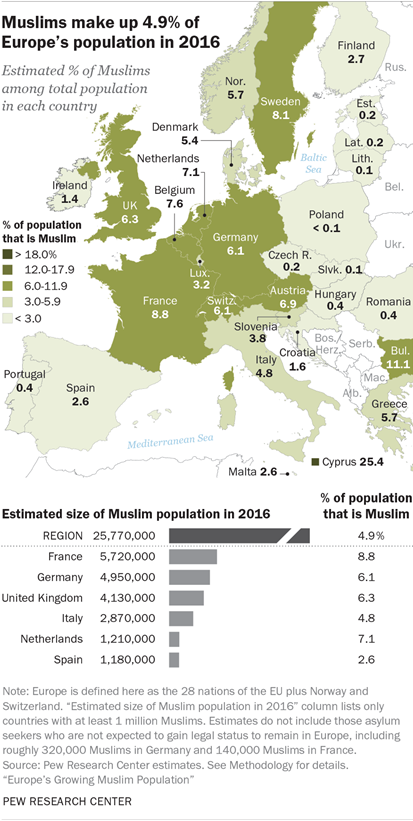
According to research by the Pew Research Center, Muslims made up about 6% of Europe’s population in 2016. Even under high-migration projections, that share is expected to reach around 14% by 2050. No mainstream demographic model predicts Muslims becoming a majority in any European country this century.
In the United Kingdom, census data from the Office for National Statistics shows Muslims account for roughly 6.5% of the population. France, Germany, and Sweden have slightly higher shares in some urban areas, but Europe overall remains overwhelmingly non-Muslim.
These figures contradict the idea of demographic “takeover.” What they do show is steady minority growth, driven by migration, higher birth rates in earlier generations, and refugee movements linked to wars in Syria, Iraq, and Afghanistan.
Security, Crime, and Misperception
Terrorist attacks by extremist groups such as ISIS or al-Qaeda have deeply shaped European public opinion. Data from Europol confirms that jihadist attacks were responsible for several high-profile incidents, particularly between 2015 and 2017.
Yet Europol also reports that most terrorist plots in Europe are foiled, and that Islamist terrorism represents only one part of the security landscape alongside far-right and separatist violence.
Crime statistics similarly show no simple link between Islam and crime. Socioeconomic factors, unemployment, segregation, education gaps, are far stronger predictors of criminal behaviour than religion. As many Muslim leaders repeatedly state, the overwhelming majority of European Muslims are law-abiding citizens.
From the perspective you describe as an Arab Muslim, this rings true: some Muslims do commit crimes, just as members of any group do, but they are a minority within a minority. Recognising this distinction is essential for honest debate.
Identity, Integration, and European Anxiety
Europe’s unease is not only about numbers or crime; it is about identity. Rapid social change, declining Christianity, and economic insecurity have left many Europeans searching for stability. Islam, visible in mosques, dress, and cultural practices, becomes a symbolic focal point for broader fears about globalization and national cohesion.
At the same time, many Muslims in Europe face discrimination, housing segregation, and barriers to employment. When integration fails on either side, mistrust grows.
Building a More Harmonised Society
A durable solution requires responsibility from multiple actors:
European governments should
- enforce secular law equally for everyone
- invest heavily in education, housing, and employment integration
- combat both Islamist extremism and anti-Muslim hatred
Muslim communities should
- openly challenge extremism within their ranks
- support civic participation and language acquisition
- emphasise that European citizenship and Muslim identity are compatible
Arab-majority countries should
- promote educational reforms that discourage sectarianism
- cooperate internationally against extremist networks
- support migration policies that prioritise stability and legal pathways
None of these steps alone solves the problem. Together, they reduce the sense of parallel societies that fuels fear on all sides.
A Shared Future
Europe is not being “taken over,” but it is changing. The challenge is not demographic conquest but social cohesion. Facts show that Muslims remain a minority, that most reject violence, and that integration outcomes depend more on policy and economics than on religion.
Ultimately, the principle that should guide both Europe and the Muslim world is simple: we are all human beings first. Societies work best when laws are fair, transparent, and applied equally — punishing those who commit crimes wherever they come from, and protecting the innocent without double standards.
If that balance is achieved, coexistence stops being a slogan and becomes a lived reality.
Have a project behind the idea?
I work on websites, branding and film. If you need help turning your next idea into something people can see and use, tell me what you have in mind.
What did you think?
A thought, a different perspective, a little appreciation. You’re welcome here.

.png)