The Introduction: Why Another Screenwriting Book?
Snyder opens by establishing his credentials and his philosophy. He is not an academic; he is a screenwriter who has sold scripts and understands the business. The book’s title comes from its most famous rule: the “Save the Cat” moment. This is a scene early in a film where the protagonist does something likable—like saving a cat from a tree—so the audience knows who to root for. The introduction sets the tone: this will be a practical, sometimes cynical, but deeply useful guide to writing scripts that actually get made. It is about connecting with the audience’s emotions, because without that connection, a movie fails.
Chapter 1: What Is It? The Logline
The first job is not to write pages. It is to know what your movie is.
Snyder argues that the foundation of any successful screenplay is a logline: a one- or two-sentence summary that captures the entire film. A good logline must satisfy four requirements:
- Irony: It must contain a conflict or contradiction that is emotionally engaging.
- A compelling mental picture: It must imply the entire movie in the reader’s mind.
- Audience and cost: It must clearly signal who the movie is for and roughly what it will cost to make.
- A killer title: The title should communicate the story’s substance cleverly.
This chapter is about high-concept thinking—the ability to pitch an idea that is immediately understandable and appealing. Snyder insists you test your logline on anyone who will listen, refining it until it consistently provokes the reaction: “Oh, I get it.” If you cannot say what your movie is in two sentences, you do not yet know what you are writing.
Chapter 2: Give Me the Same Thing... Only Different!
Genre, Snyder argues, is too broad a category. “Romantic comedy” tells you nothing useful about the story’s engine. He proposes ten story types that every movie falls into, each with its own rules and primal appeal:
- Monster in the House: A contained threat (a shark, a ghost, a killer) and a group trapped with it. (Jaws, Alien, The Exorcist)
- Golden Fleece: A quest for a prize, where the journey matters more than the destination. (Star Wars, The Wizard of Oz, Back to the Future)
- Out of the Bottle: A wish or magic spell causes problems. (Groundhog Day, Bruce Almighty, Freaky Friday)
- Dude with a Problem: An ordinary person thrown into an extraordinary crisis. (Die Hard, Titanic, Schindler’s List)
- Rites of Passage: A character navigates a life transition. (Ordinary People, Days of Wine and Roses)
- Buddy Love: Two characters are bound together, and the story is about their relationship. (Rain Man, E.T., Butch Cassidy and the Sundance Kid)
- Whydunit: A mystery where the question is not who did it, but why. (Citizen Kane, Chinatown)
- The Fool Triumphant: An underdog or outsider proves the world wrong. (Forrest Gump, Amadeus)
- Institutionalized: A group or institution is the antagonist. (The Firm, MASH)*
- Superhero: A special being exists in a mundane world. (Superman, The Matrix)
The lesson is: know the rules of your story type so you can deliver the primal pleasure the audience came for, while still finding a way to make it fresh.

Chapter 3: It’s About a Guy Who...
The hero is the audience’s entry point. Snyder’s key principle here is that the hero must serve the idea. The protagonist is not just a person; they are the character for whom the stakes are highest and who will change the most.
The hero’s goal must be driven by a primal urge—a fundamental human need like survival, protection of family, love, or revenge. Without a primal stake, the audience cannot connect. Snyder also discusses the hero’s need to be active, to lead the story rather than be dragged along by it. This chapter is a character workshop, ensuring the person at the center of your plot is worth following.
Chapter 4: Let’s Beat It Out!
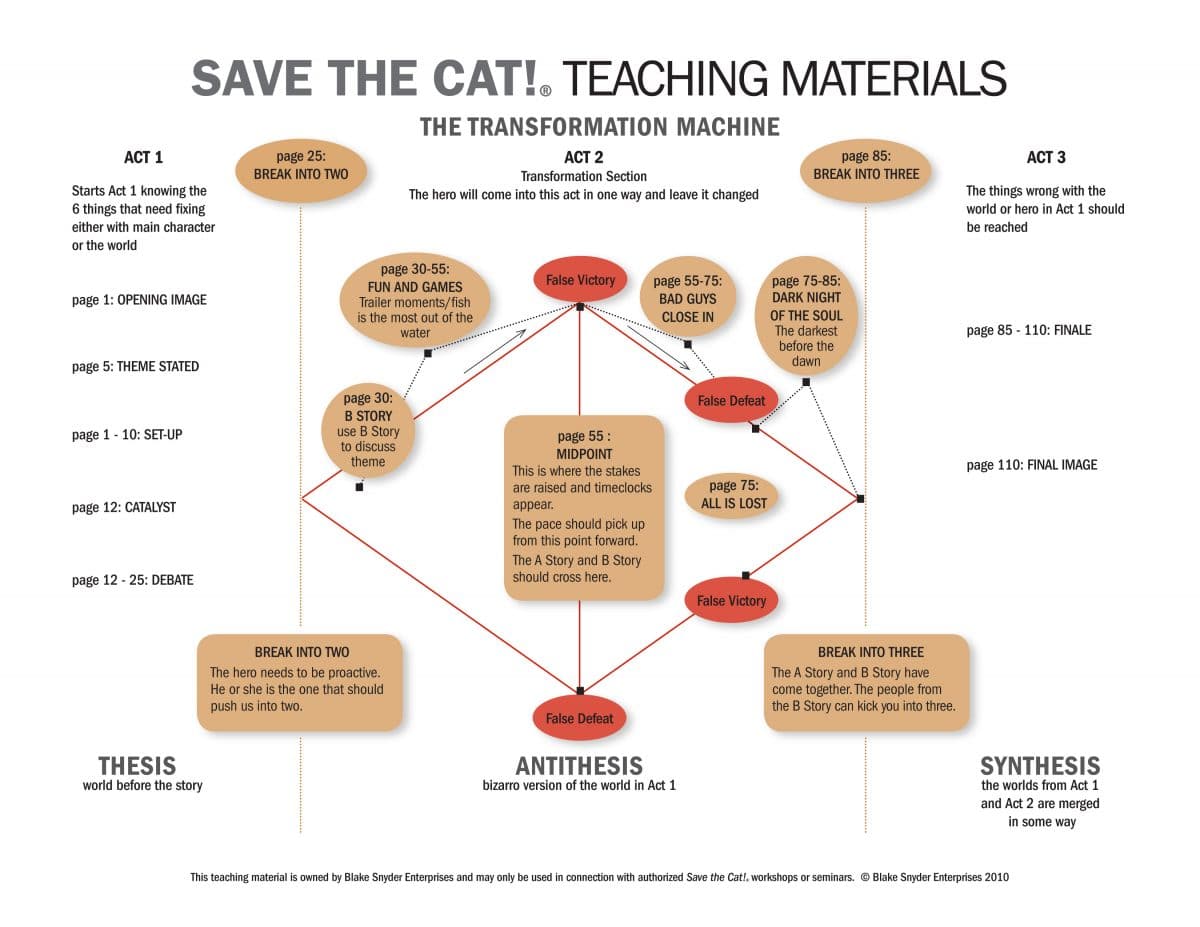
This is the heart of the book. Snyder introduces the Blake Snyder Beat Sheet (BS2), a fifteen-beat structure that maps a story from page one to the end. It divides a roughly 110-page screenplay into three acts, with Act Two split into two halves by a midpoint. The fifteen beats are:
- Opening Image: A visual that sets the tone and shows the hero’s starting point.
- Theme Stated: A line of dialogue that hints at the story’s lesson.
- Set-Up: Introduce the hero’s ordinary world and its flaws.
- Catalyst: The event that disrupts the status quo.
- Debate: The hero hesitates, questioning whether to act.
- Break into Two: The hero chooses to enter the upside-down world of Act Two.
- B Story: A secondary plot, often a relationship, that carries the story’s theme.
- Fun and Games: The “promise of the premise,” where the hero explores the new world.
- Midpoint: A false victory or false defeat that raises the stakes and changes the trajectory.
- Bad Guys Close In: The pressure mounts, and the hero’s allies fall away.
- All Is Lost: The lowest point, often marked by a “whiff of death.”
- Dark Night of the Soul: The hero wallows in despair before finding the strength to continue.
- Break into Three: The hero uses the lessons from the B Story to formulate a new plan.
- Finale: The hero confronts the antagonist and resolves the story.
- Final Image: A mirror of the Opening Image, showing how the hero has changed.
Snyder explains each beat in detail and demonstrates how they apply to the film Miss Congeniality. This chapter is a blueprint.
Chapter 5: Building the Perfect Beast
The Beat Sheet is the skeleton; the board is the flesh.
Snyder recommends a physical corkboard divided into four horizontal rows, one for each major section of the film (Act One, Act Two-A, Act Two-B, Act Three). On this board, you place forty index cards and forty only—one for each scene. Each card represents a scene and includes a note on the conflict and the emotional shift within that scene.
This chapter is about troubleshooting the structure visually. If Act Two is sagging or Act Three feels thin, the board reveals it immediately. Snyder also compares a screenplay to a business plan: it must be organized, persuasive, and clear, because you are not just writing a story; you are preparing a pitch document that will be judged by executives.
Chapter 6: The Immutable Laws of Screenplay Physics
These are Snyder’s “ironclad rules,” born from experience, that govern why some scripts work and others fail. The laws include:
- Save the Cat: The hero must do something likable early on so the audience invests in them.
- The Pope in the Pool: If you have to deliver exposition, bury it in a visually interesting setting (like a character swimming in a pool while the Pope talks), so the audience is distracted by the scenery while absorbing the information.
- Double Mumbo Jumbo: Do not ask the audience to believe in two impossible things at once. One supernatural element per story is enough.
- Laying Pipe: Get the setup done quickly. Do not spend too long before the story kicks in.
- Too Much Marzipan (Black Vet): Do not pile too many ideas onto one concept. A story cannot be about everything.
- Watch Out for That Glacier!: Make the threat imminent. If the danger moves at a glacial pace, the audience loses interest. The villain or problem must be closing in now.
- Covenant of the Arc: The protagonist must change; the antagonist must not. The hero’s transformation is the point of the story.
These laws are not suggestions. They are the physics of the medium, and breaking them usually results in a script that does not work.
Chapter 7: What’s Wrong with This Picture?
You have finished a draft. It is 110 pages of what feels like nada. This chapter is the diagnostic manual.
Snyder offers six fast double-checks to identify and repair a broken script:
- The Hero Leads: Is your protagonist active, or are they being dragged through the plot?
- Make the Bad Guy Badder: Is the antagonist threatening enough to justify the hero’s struggle?
- Turn, Turn, Turn: Does the story have enough reversals and surprises?
- The Emotional Color Wheel: Does the script navigate a full range of emotions, or is it stuck on one note?
- “Hi How Are You I’m Fine”: Is the dialogue doing more than one thing at once, or is it flat and on-the-nose?
- Take a Step Back: Can you see the hero’s arc clearly? Does the character actually change from beginning to end?
This chapter is about rewriting as diagnosis, not just “tweaking until it sounds better.” You name the disease before you treat it.
Chapter 8: Final Fade In
The script is written. Now comes the hardest part: selling it and building a career.
Snyder discusses the business of screenwriting—how to get an agent, how to pitch, how to network, and how to survive the rejection that comes with the territory. His advice is practical and sometimes blunt: if you want to make it, you may need to move to Los Angeles. You need contacts. You need to be in the rooms where decisions are made. The chapter is a reality check: the writing is only half the job. The other half is persistence, strategy, and the willingness to keep going when the industry says no.
Have a project behind the idea?
I work on websites, branding and film. If you need help turning your next idea into something people can see and use, tell me what you have in mind.
What did you think?
A thought, a different perspective, a little appreciation. You’re welcome here.