Ousmane Sembène and the Power of Giving People the Frame
Who gets to explain the world Who gets listened to And who is expected to remain in the background while somebody else speaks
Those questions are a useful way into the cinema of Ousmane Sembène.
The Senegalese filmmaker was also a novelist. His work confronts colonial power, the behaviour of elites and the pressures placed on ordinary people. But what interests me most is how those concerns become situations that can be seen and felt.
A job. A letter. An official document. A decision about who belongs in a room.
My reading is that political cinema becomes especially powerful when the audience can see the machinery of power working inside a person's daily life. Sembène gives us that kind of attention.
Black Girl and the Distance between a Promise and a Life
Black Girl, released in 1966, follows Diouana, played by Thérèse Mbissine Diop, who travels from Senegal to work for a French couple. The situation becomes one of confinement and exploitation.
For me, the important tension lies between what a journey seems to promise and what the destination allows. Moving to another country does not automatically mean gaining control over your life. An employer's home can become a place where your own expectations are steadily reduced.
The film uses Diouana's voice to make her experience present. I read that as a crucial formal decision. A person can be silenced by the people around her without the film agreeing to that silence.
A Money Order Becomes a System
Mandabi, released in 1968, is a Wolof language feature about a man trying to cash a money order. Criterion describes a situation in which bureaucracy, family demands and opportunism complicate the promised relief.
What I find strong about that premise is its scale. The central task is easy to understand. The obstacles reveal a whole social structure.
A document is never merely a piece of paper when an institution decides that the paper determines whether you can act. The audience can understand that pressure before anyone names it as a political problem.
My interpretation is that this gives the satire its bite. The absurdity is funny, but its consequences belong to somebody who cannot simply walk away from them.

Language Is Part of the Form
Sembène's work includes films in African languages as well as French. The BFI identifies Mandabi's use of Wolof as an important part of the career, alongside films such as Xala and Moolaadé.
That matters because language is part of who a film addresses. It shapes an encounter with an audience. It affects whose everyday speech is allowed to carry a cinematic story.
I think filmmakers should ask that question more often. Who is this film speaking with Whose experience is being translated for whom What changes when a person hears the world of the film in a familiar voice
A Final Thought
I would begin with Black Girl and Mandabi. Watch the practical details. The work someone performs. The thing someone needs. The authority someone has to approach.
The lesson I take from Sembène is to make power visible through consequences. We understand a system more clearly when we understand what it does to a person trying to live.
And giving that person the centre of the frame is already a decision about what deserves our attention.
Sources and Image Credits
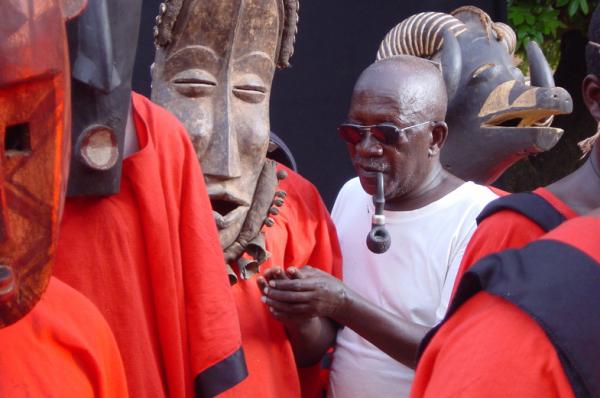
Sembène photograph from the production of Moolaadé and Black Girl still via BFI. Original image rights remain with their holders.
References and Image Credits
Film titles, dates, plot details and career landmarks were checked against the sources below. The critical readings in this article are interpretations, rather than statements of a filmmaker's intention.
Sembène photograph from the production of Moolaadé and Black Girl still via BFI. Original image rights remain with their holders.
Have a project behind the idea?
I work on websites, branding and film. If you need help turning your next idea into something people can see and use, tell me what you have in mind.
What did you think?
A thought, a different perspective, a little appreciation. You’re welcome here.