What AI Actually Is and What It Is Not
There is a strange thing about the way we talk about artificial intelligence. A system that sorts photographs, a chatbot that writes a paragraph and software that predicts equipment failure can all receive the same label. Then the label begins doing more work than the explanation.
I want this series to slow that conversation down. Before asking whether AI will change everything, it helps to ask what a particular system takes in, what it produces and how we would know it worked.
Start with the task
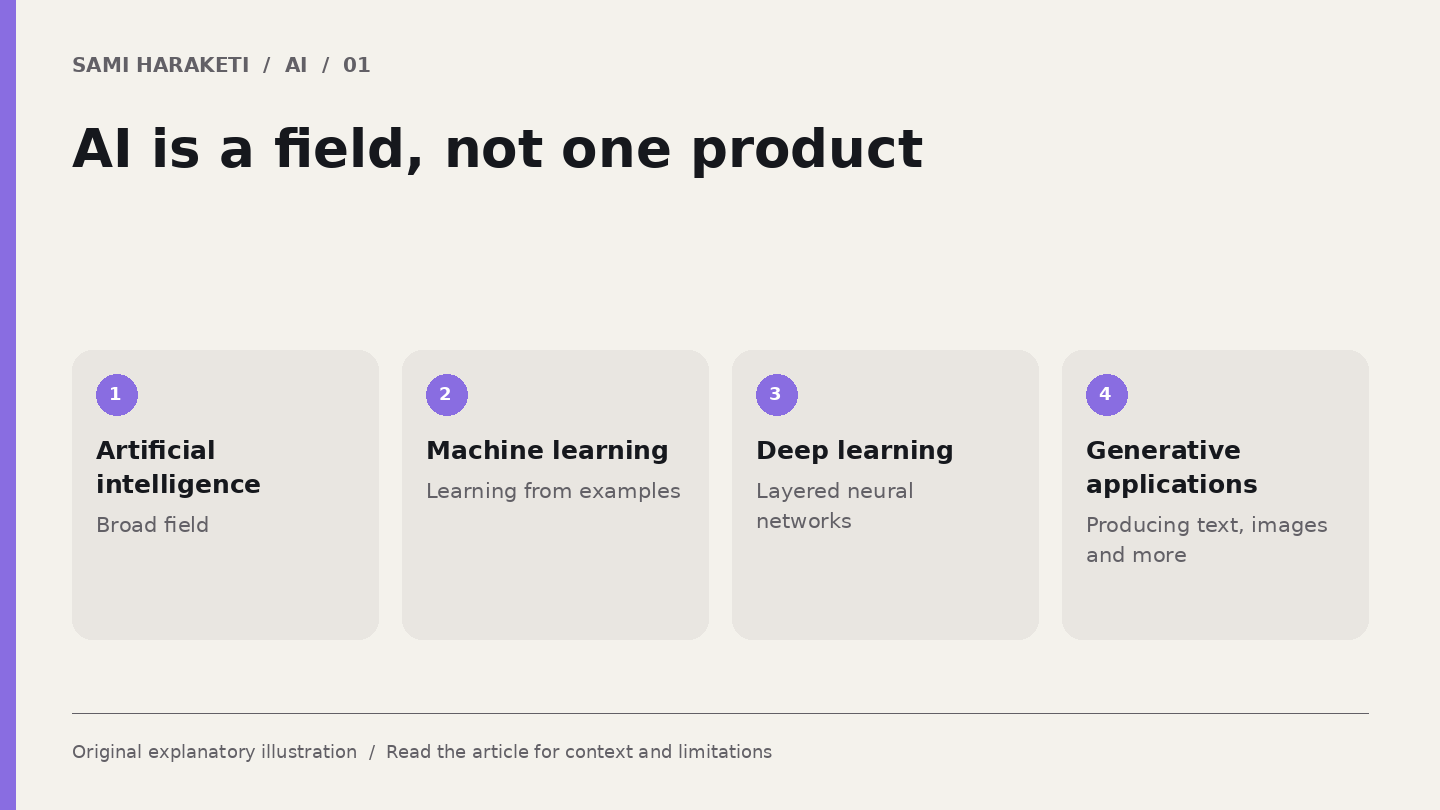
Artificial intelligence is a broad field. Machine learning is one part of it: instead of specifying every decision as a handwritten rule, developers fit a model using examples. Deep learning is a family of machine learning methods built around neural networks with multiple layers. Generative systems produce outputs such as text or images. These terms overlap, but they do not describe interchangeable products.
That distinction matters when you buy a tool. A system that identifies a damaged component needs different evidence from one that suggests a headline. Both might be useful. Neither becomes suitable simply because its website says AI.
My first question would be very ordinary: what is the job that needs doing?
Prediction is not a promise
Consider a fictional archive of film production documents. You might want to classify invoices, retrieve a location agreement or draft a production summary. Classification, search and generation are different tasks. A convincing summary cannot tell you whether an invoice was classified correctly.
For this archive, I would write three separate requirements. An invoice sorter should route documents into the correct folders. A search tool should return the actual agreement requested. A summary tool should preserve dates, names and conditions without adding anything. That is already a more useful brief than asking for an intelligent assistant.
Next, define what happens when the system is uncertain. Does it flag a document for someone to check? Does it return a source? Can the person undo the change? Those are design decisions around the model, and they deserve as much attention as the model itself.
A demonstration can show that something is possible. It cannot establish how reliably it will work on your material. Bring your awkward examples: a blurred scan, a missing page, two projects with similar names. These are proposed tests, not evidence of a system's actual performance.
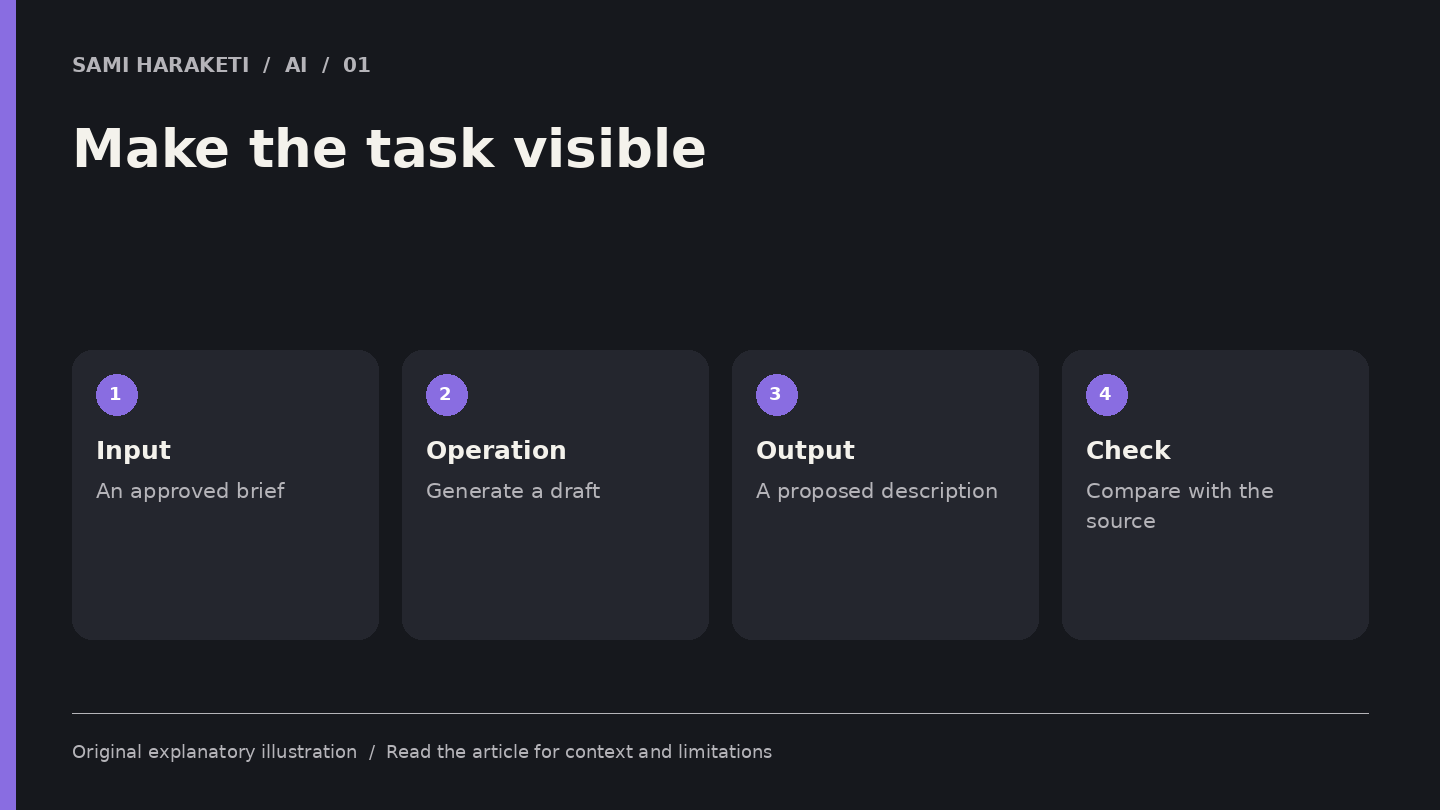
A useful way to inspect an AI product
Draw four boxes on paper: input, operation, output and check. Put a real example inside each. If one box remains vague, keep asking questions before committing your work.
For a drafting tool, the input could be an approved project brief. The operation is text generation. The output is a proposed description. The check is a comparison against the brief, followed by an editorial decision. You have identified a bounded use and a responsible person.
I would also ask where the information goes, who can access it, whether the supplier can explain its limitations and what happens when the service is unavailable. A small, reversible trial is easier to judge than a complete change of workflow.
None of this requires you to become a researcher. It requires you to keep the task visible when the marketing becomes loud.
For the next article, we need one more distinction: training a model and using a trained model are different operations. Confusing them makes it much harder to understand privacy, cost and what a conversation actually changes.
This is part one of a twenty article introduction to AI. The aim is to understand enough to make useful decisions, without pretending that a fluent answer is the same as a reliable one.
Sources and further reading
Research checked on October 5, 2026. Original explanatory illustrations by Sami Haraketi, prepared for this article.
Sources and further reading
Research checked on October 5, 2026. Original explanatory illustrations by Sami Haraketi, prepared for this article.
What did you think?
A thought, a different perspective, a little appreciation. You’re welcome here.
.png)