Ways of Seeing and the Habit of Looking Twice
An image can be familiar without being understood. We recognise the painting, the photograph or the advertisement, then move on before asking what it is asking of us.
John Berger's Ways of Seeing was first published in 1972 and grew out of the BBC television series. Its value for a designer or filmmaker is not a collection of styles to imitate. It is a reason to slow down the act of looking.
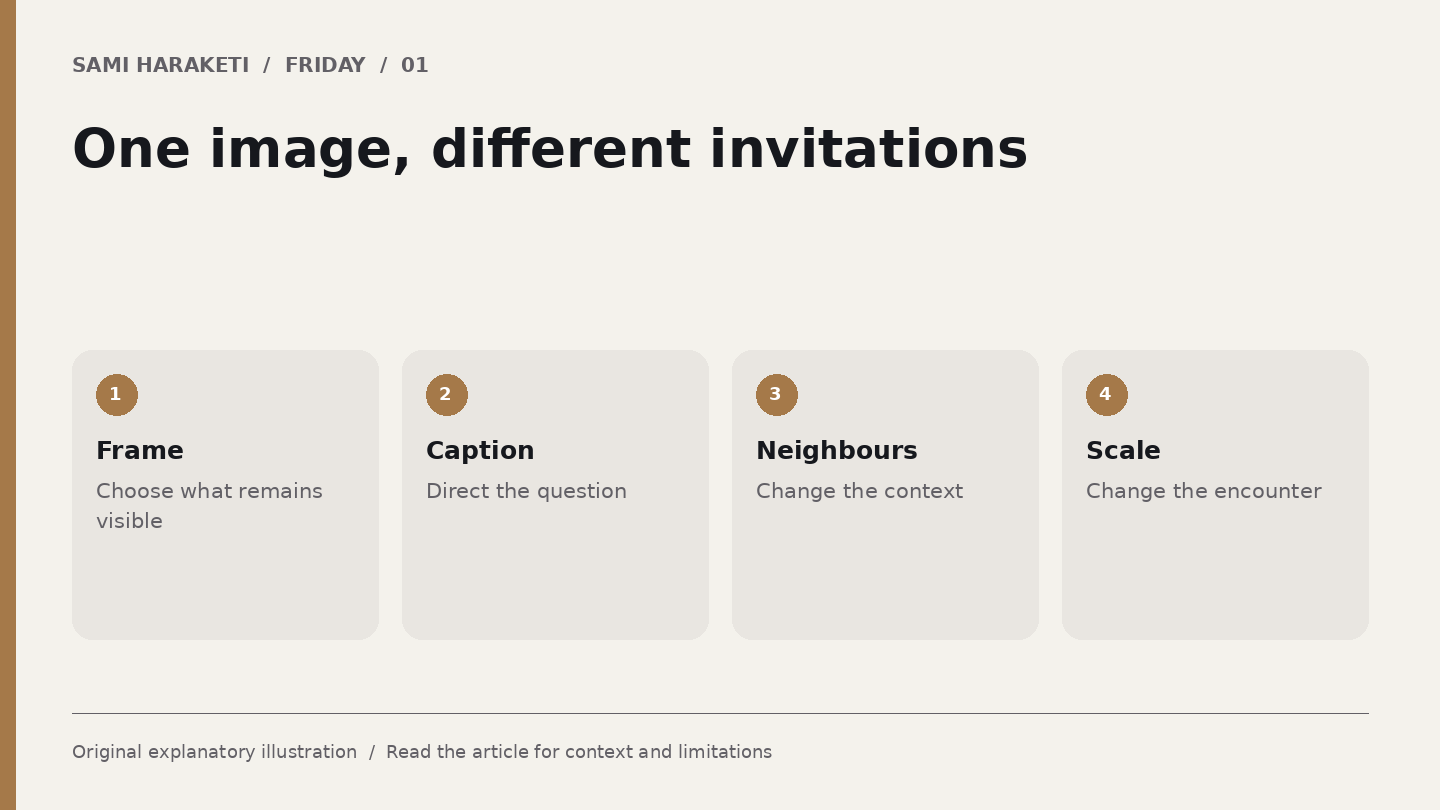
Berger's discussion of reproduced images considers how their meaning changes when they travel into different contexts. A picture does not arrive on a page alone. Its neighbours, scale and accompanying words influence the encounter.
The frame is already a decision
I find that idea especially useful for websites. A photograph in a full width opening section has a different job from the same photograph inside a project archive. One introduces an identity; the other may provide evidence.
The image has not changed, but the invitation to look at it has.
A small exercise in context
Imagine a photograph of an empty chair beside a window. Put it on a page titled “Waiting.” Then place it on a page titled “The Studio.”
The first title invites a story about absence or expectation. The second directs attention toward a working environment. Neither caption changes the pixels. Both help organise what a viewer notices.
This is my own exercise inspired by the question of context, not an example Berger supplies.
Try it with a project image. Remove the caption and ask what remains understandable. Add a precise caption describing the work and your contribution. Compare that with a broad phrase such as “A powerful experience.”
The precise version may be less dramatic, but it gives the image a relationship to something real. It lets a reader inspect the work rather than borrowing the atmosphere of importance.
For filmmaking, the neighbouring image performs a similar role. A quiet face can acquire a different significance depending on the shot placed before it.
What I take from the book's approach
Ways of Seeing is most useful when treated as an argument to examine rather than a source of phrases to repeat. Its historical discussion does not describe every contemporary platform, but the questions about looking remain productive.
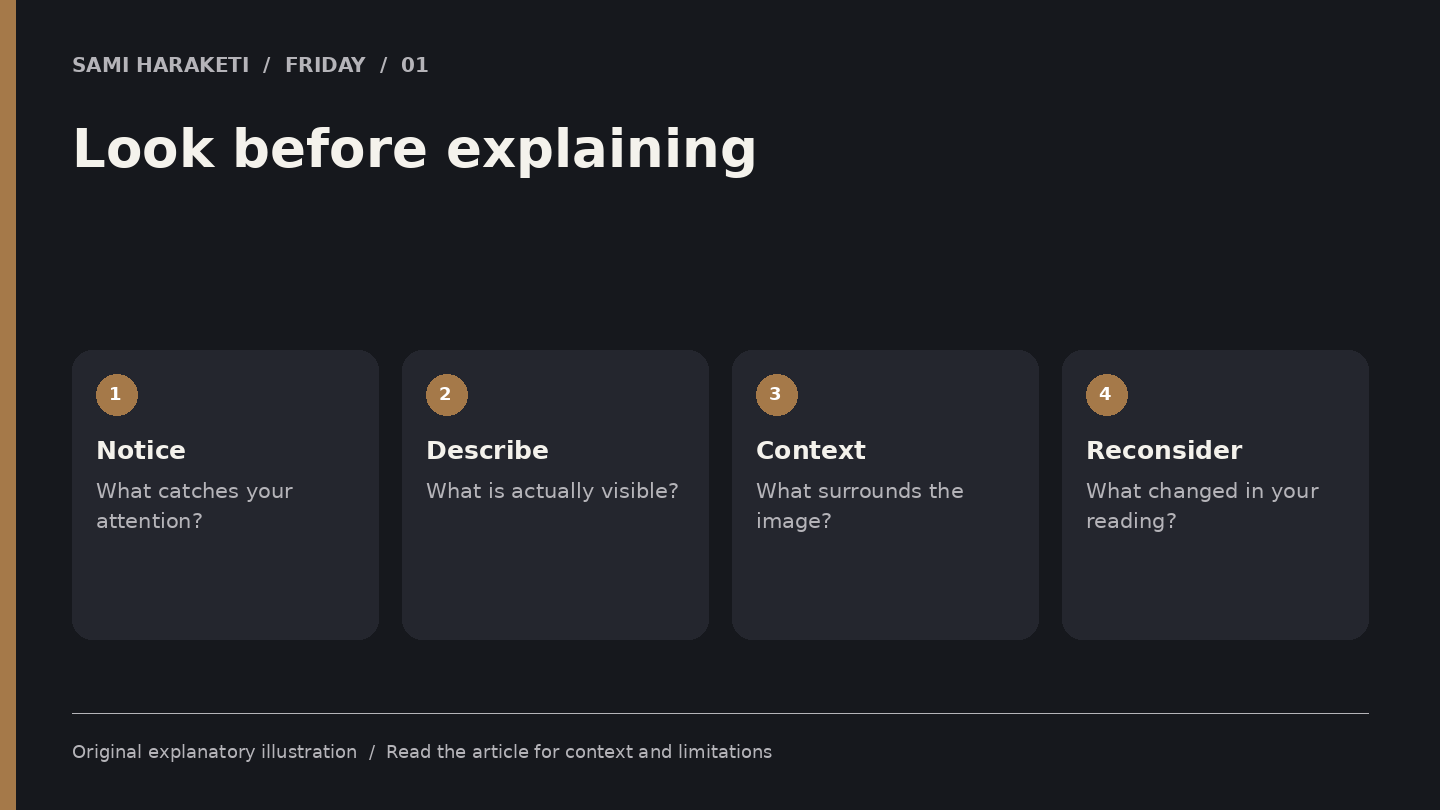
I would pair the text with actual images and make disagreements specific. Does the proposed interpretation account for what is visible? What changes when the image is cropped, repeated or surrounded by another message?
The limitation of applying any critical framework too eagerly is that the image can disappear behind the explanation. Leave room for what you notice before deciding which concept it must illustrate.
For my work, the practical consequence is simple: choose images with a clear purpose and write captions that help people see what matters. A beautiful picture can still be used vaguely.
Berger gives us a demanding starting question. Before asking whether an image is attractive, ask what kind of looking the arrangement encourages. That question can improve a film frame, a portfolio page and the way we encounter images every day.
Sources and further reading
Research checked on October 5, 2026. Original editorial illustrations prepared for this series and reused across related discussions where relevant.
Sources and further reading
Research checked on October 5, 2026. Original editorial illustrations prepared for this series and reused across related discussions where relevant.
What did you think?
A thought, a different perspective, a little appreciation. You’re welcome here.

.png)