
FIT4CEA: The European Project Building the Future of Food, One Greenhouse at a Time
Europe's food systems are under pressure. Climate change is disrupting harvests, water scarcity is tightening its grip, and geopolitical instability is exposing the fragility of supply chains that once seemed secure. In the face of these converging crises, a quiet revolution is taking root—not in open fields, but in controlled environments where every variable, from light to temperature to nutrient flow, can be precisely managed. At the center of this revolution is FIT4CEA, a Horizon Europe project that is bringing together the brightest minds and most innovative companies across the continent to unlock the full potential of Controlled Environment Agriculture (CEA).
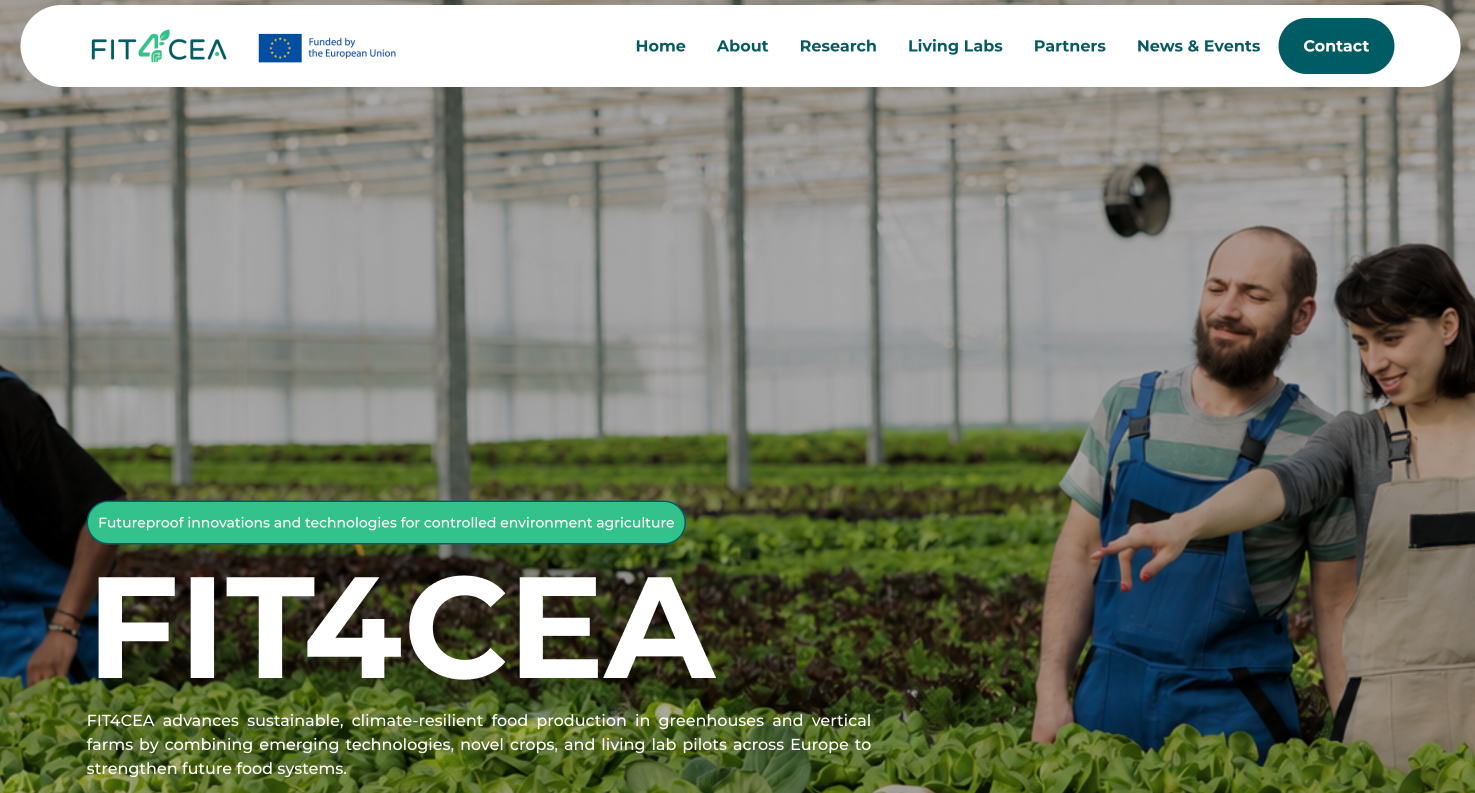
What Is FIT4CEA?
FIT4CEA stands for "Futureproof Innovations and Technologies for Controlled Environment Agriculture." It is a four-year, €6 million initiative funded under the European Union's Horizon Europe program, specifically the call HORIZON-CL6-2025-02-FARM2FORK-08. The project officially launched in January 2026 and will run until May 2030. Its mission is bold: to transform CEA from a niche technology into a future-proof, climate-resilient food production system capable of delivering healthy, nutritious fruits and vegetables to European citizens regardless of what the climate throws at them.
FIT4CEA is not simply about building better greenhouses. It is about rethinking the entire relationship between food, technology, and society. The project adopts a holistic approach that bridges social and natural sciences, examining CEA across a wide spectrum of typologies—from low-tech greenhouses to high-tech vertical farms—and tailoring solutions to the diverse regional contexts of Europe and beyond.
The Research Pillars of FIT4CEA
FIT4CEA is built around several interconnected research areas, each addressing a critical dimension of sustainable food production.
The first is nutritional value over yield alone. Rather than measuring success solely in kilograms per hectare, FIT4CEA is investigating novel crops that can expand the diversity of CEA produce, with a focus on micronutrients, proteins, and bioactive compounds that are essential for human health.
The second is fossil-free, emissions-free, and circular production. The project is developing technologies that eliminate dependence on fossil resources, close material loops, and make greenhouse operations genuinely sustainable.
The third is smart and integrated production. FIT4CEA is integrating emerging tools—sensors, photonics, the Internet of Things, artificial intelligence, and affordable robotics—to boost crop productivity and optimize renewable energy use.
The fourth is sectoral synergy. The project is exploring how CEA can connect with adjacent sectors, including aquaponics, energy grids, and urban building systems, creating integrated solutions that go far beyond the greenhouse walls.
Living Labs: Where FIT4CEA Meets the Real World
Innovation is meaningless if it stays in the laboratory. That is why FIT4CEA has established four Living Labs across Europe—in the Netherlands, Spain, Italy, and Greece—where new technologies, software solutions, AI applications, and cultivation strategies are tested in real production environments. Each Living Lab addresses a different regional context and CEA typology, ensuring that the solutions developed are adaptable and scalable.
In Greece, the Agricultural University of Athens is leading work on real-time control of optimal root-zone conditions to maximize water and nutrient use efficiency. In Spain, the Universidad de Almería, working with COEXPHAL, is testing innovations in one of Europe's most important greenhouse regions. In Italy, the University of Bologna is conducting trials at AlmaVFarm, its experimental vertical farm, developing optimized cultivation protocols for novel and highly nutritious crops. And in the Netherlands, Wageningen University & Research is coordinating the overall effort, bringing its world-leading expertise in horticulture and product physiology to bear on every aspect of the project.
The FIT4CEA Consortium: A Pan-European Alliance
No single institution can solve the challenges FIT4CEA has set for itself. That is why the project brings together a consortium of 21 partners from 12 countries, including research institutes, universities, small and medium-sized enterprises, and trade associations. The consortium is coordinated by Wageningen University & Research in the Netherlands, and includes partners such as Agroscope (Switzerland), the University of Bologna (Italy), the Agricultural University of Athens (Greece), COEXPHAL (Spain), INESC TEC (Portugal), BGI (Portugal), Blue Radix (Netherlands), Kilowatt (Italy), and IVL Swedish Environmental Research Institute (Sweden), among others.
The project also has a global reach, with non-EU partners including Seoul National University in South Korea and Université Laval in Canada. This international dimension ensures that the solutions developed by FIT4CEA are not limited to Europe but can contribute to global food security.
Work Packages: The Engine of FIT4CEA
The project's activities are organized into eight integrated work packages, each led by a partner with specialized expertise. Project management and coordination are handled by Wageningen University. COEXPHAL leads the assessment of the state of the art. Agroscope leads the evaluation of social, economic, and environmental sustainability. The University of Bologna leads the work on diverse and nutritious food. The Agricultural University of Athens leads the circular production without emissions work package. Wageningen University & Research leads the fossil-free and circular systems work. INESC TEC leads future trajectories, adoption, and best practices. And BGI leads communication, dissemination, and exploitation.
This structure ensures that FIT4CEA is not a collection of isolated research projects but a coordinated, integrated effort to transform the CEA sector.
Why FIT4CEA Matters
The stakes could hardly be higher. Europe's food systems are facing pressures that would have seemed unimaginable a generation ago. Climate change is making traditional agriculture increasingly unpredictable. Water scarcity is limiting irrigation in many regions. Geopolitical instability is disrupting supply chains and raising questions about the security of food imports.
In this context, CEA offers a way forward. By growing food in controlled environments, it is possible to produce more with less—less water, less land, fewer chemical inputs—while ensuring consistent quality and year-round availability. But CEA is not a silver bullet. It requires significant energy inputs, sophisticated technology, and a skilled workforce. That is why FIT4CEA is so important. It is not simply promoting CEA; it is working to make it genuinely sustainable, economically viable, and socially accepted.
The project's emphasis on nutritional value is particularly significant. In a world where food security is often measured in calories, FIT4CEA is asking a more important question: are we producing food that actually nourishes people? By focusing on micronutrients, proteins, and bioactive compounds, the project is aligning with the growing recognition that food security must be about quality as well as quantity.
A Project for Everyone
One of the most striking aspects of FIT4CEA is its commitment to adoption and uptake. The project is not content to produce academic papers and laboratory results. It is working with growers, trade associations, and SMEs to ensure that the innovations developed are practical, affordable, and scalable. The Living Labs are a crucial part of this effort, providing real-world testing grounds where farmers and technologists can collaborate.
This collaborative ethos extends to the project's communication and dissemination work, led by BGI. The goal is not just to inform but to engage—to build a community of practice around CEA that includes researchers, growers, policymakers, and citizens. The project's website serves as a central hub for this community, providing updates, resources, and opportunities for involvement. To visit it, go to https://fit4cea.eu.
The Road Ahead
FIT4CEA is still in its early stages, but its ambition is already clear. Over the next four years, the project will develop and validate a suite of innovations that could reshape the way Europe grows its food. It will train a new generation of researchers and practitioners. It will generate evidence that policymakers can use to support sustainable agriculture. And it will demonstrate that CEA can be a cornerstone of a resilient, nutritious, and equitable food system.
The challenges are immense, but so are the opportunities. With its pan-European consortium, its global reach, and its holistic approach, FIT4CEA is well positioned to make a lasting impact. For anyone interested in the future of food, it is a project worth watching—and, more importantly, worth supporting.
To learn more about FIT4CEA, to explore the consortium, and to follow the project's progress, visit https://fit4cea.eu.

Have a project behind the idea?
I work on websites, branding and film. If you need help turning your next idea into something people can see and use, tell me what you have in mind.
What did you think?
A thought, a different perspective, a little appreciation. You’re welcome here.

