Embeddings and the Search That Understands Similarity
A person searching for “permission to film here” may be looking for a document titled Location Release Agreement. A search based only on matching those exact words might struggle.
Semantic search tries to connect related meanings. Text embeddings are one way to make that possible. They are useful, but they do not turn a search result into a verified answer.
Text becomes a numerical representation
An embedding model represents text as a vector: an ordered collection of numbers. A search system can compare the representation of a query with representations of documents or passages.
Sentence Transformers documents several similarity measures, including cosine similarity. Cosine similarity compares vector direction. The choice of model, representation and similarity measure influences the results.
There is no universal score that means a passage is true or relevant enough for every task. A similarity score describes a relationship under the chosen method. It does not verify a date, establish permission or confirm that a document is current.
That distinction is easy to miss when results arrive in a neatly ranked list. The list is an invitation to inspect the material, not a substitute for doing so.

Exact details still matter
Imagine a fictional film archive containing location agreements, equipment rentals and release forms. A query about filming permission could reasonably return several related documents. Only one may apply to the location and production you mean.
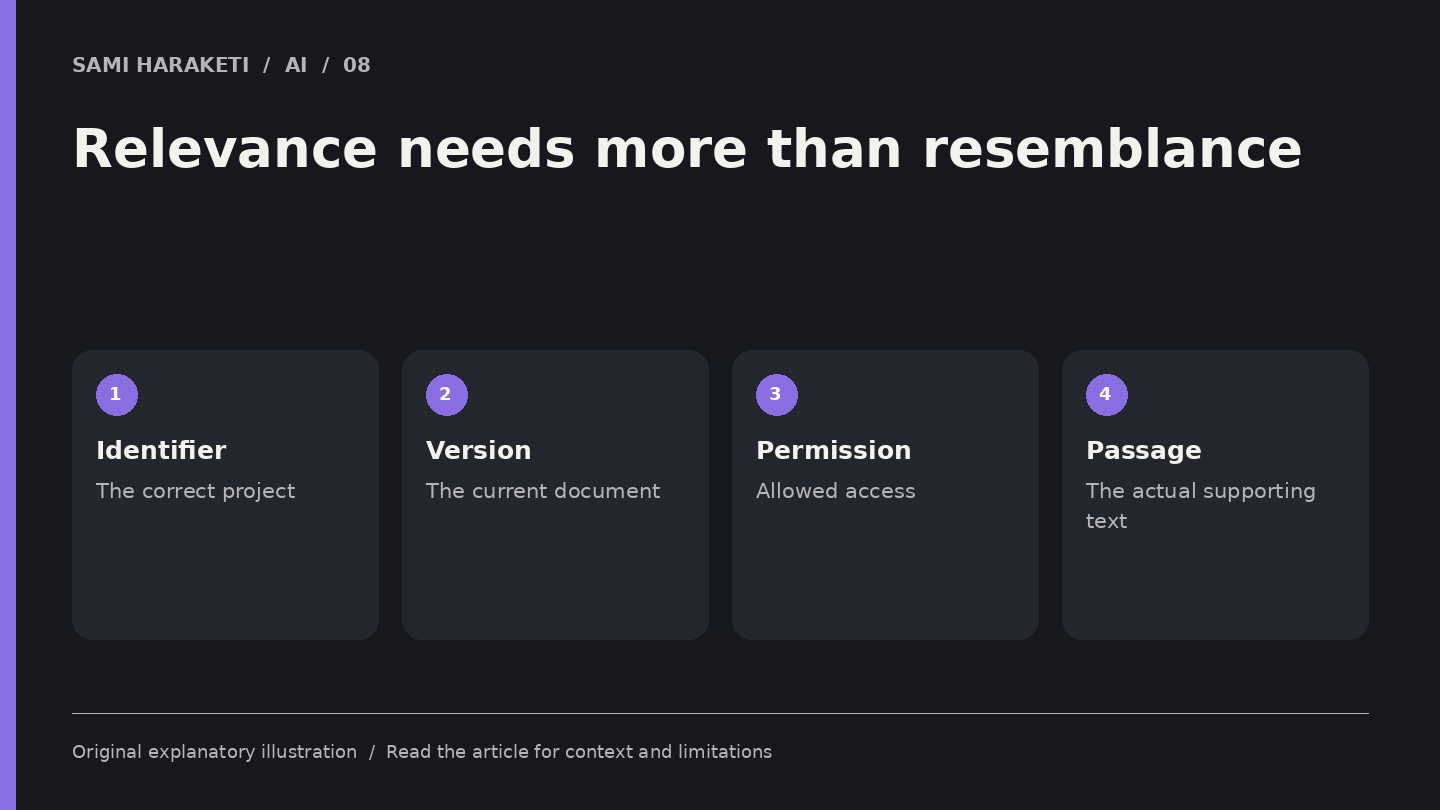
I would store useful metadata alongside the text: production identifier, document type, version date and access permissions. Filtering on those fields can narrow the search before or alongside similarity ranking.
Exact matching also remains valuable. If you search for a particular contract number, a semantically similar contract is not necessarily helpful. A practical system may combine keyword and semantic methods, but that combination needs its own evaluation.
For multilingual material, do not assume that a model handles every language equally well because it supports more than one. Assemble representative queries in the languages your users actually use, including mixed language names and specialist vocabulary.
These are suggested design and testing steps. I am not claiming a particular model will pass them without measurement.
Build a small relevance test
Start with questions whose correct source documents you already know. Write down which results would be useful and which would be misleading. Include queries with exact identifiers, paraphrases, missing information and similar names.
Then inspect the first results. Did the expected document appear Was the right passage visible Did an obsolete copy outrank the approved one Can a user recognise the difference from the result preview
A production archive offers a particularly useful awkward case: two projects with the same working title. Add that to your test. A result that looks excellent in a demonstration may be risky when it crosses project boundaries.
If the search feeds a generating model, keep the source title and relevant passage available to the reader. That makes checking possible and can help distinguish a retrieval failure from a writing failure.
I would also plan how the index is updated when documents change or are removed. A beautifully ranked stale archive is still stale.
Semantic search can make information easier to find when people do not know its exact wording. Its value depends on preserving the details that similarity alone cannot establish. Meaningful resemblance is useful. The right record is what you actually need.
Sources and further reading
Research checked on October 5, 2026. Original explanatory illustrations by Sami Haraketi, prepared for this article.
Sources and further reading
Research checked on October 5, 2026. Original explanatory illustrations by Sami Haraketi, prepared for this article.
Have a project behind the idea?
I work on websites, branding and film. If you need help turning your next idea into something people can see and use, tell me what you have in mind.
What did you think?
A thought, a different perspective, a little appreciation. You’re welcome here.